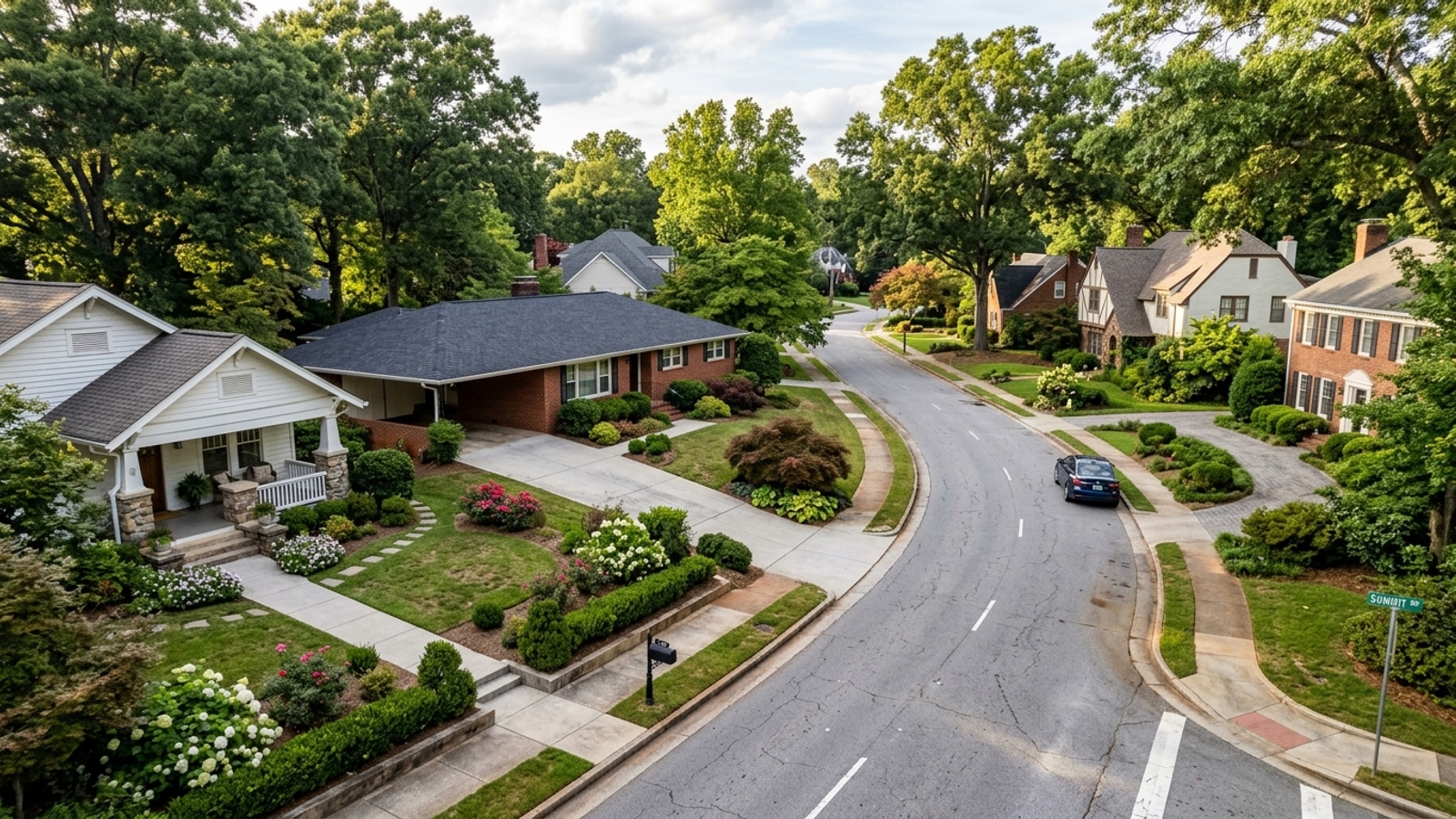
The median sale price for a home in Greenville County sits around $368,146 as of mid-2026 - up slightly from last year. Buyers searching for homes for sale in Greenville, SC will find a diverse market. If you're looking within the city limits, expect higher numbers, often somewhere between $480,000 and $525,000 depending on the exact boundaries and data methodology used.
Choosing a neighborhood means weighing housing types, proximity to downtown, and commute times across the Greenville-Spartanburg metro. The housing stock runs from early-1900s bungalows near the city center to contemporary single-family homes and attached townhouses further out. Those are very different buying experiences, and the right fit depends on what you're actually trying to solve for.
How Greenville Neighborhoods Are Organized
Greenville County covers a massive footprint. The city itself, though, is organized around distinct historic districts, commercial corridors, and residential grids - north, south, and west sides, each with its own architectural character and lot sizes.
Most buyers start by orienting themselves relative to downtown landmarks like Falls Park on the Reedy or the Swamp Rabbit Trail. That's a reasonable instinct. Where a property sits relative to the city limits also matters in a practical way - it affects your property taxes, municipal services, and often the purchase price itself.
Homes inside the city proper fall under different jurisdictions than those in unincorporated Greenville County. Those boundary lines dictate everything from trash collection to zoning rules for exterior renovations.
City Limits Versus Greenville County
Properties inside the city limits are closer to the urban core and its commercial amenities - and they're priced accordingly. Denser land use and access to city-maintained infrastructure both factor into those higher price tags.
Unincorporated Greenville County tends to offer larger lots and lower median prices. If you're looking outside the immediate downtown radius, you'll find a mix of older subdivisions and newer developments spread across the broader metro.
Using Maps to Identify Boundaries
Interactive maps let you see the exact lines between specific subdivisions and historic zones. Local associations and the city government both maintain boundary maps for areas like the West End or Overbrook, and it's worth pulling those up before you start touring.
Knowing whether a listing sits inside a designated historic district or a standard residential zone matters - those designations dictate what you can and can't do with additions and renovations.
Greenville Neighborhoods by Home Type and Price
Zillow's mid-2026 data puts the average Greenville, SC home value at roughly $330,858. That number moves around a lot depending on a property's age, style, and exact location within the county.
The local market covers a wide range - detached single-family houses on mature lots, attached housing near commercial centers, and plenty in between. Knowing which property type you're after early on will save you from touring homes that won't work regardless of price.
Zoning and historical designations shape the available inventory in ways that aren't always obvious from a listing description. Some neighborhoods are almost entirely preserved early-20th-century homes. Others mix original structures with modern infill construction on the same block.
Historic Districts and Established Homes
Greenville has seven officially recognized historic districts: Colonel Elias Earle, East Park Avenue, Hampton-Pinckney, Heritage, Overbrook, Pettigru, and West End. Pettigru is the largest - over 70 structures built largely between 1910 and 1930 - and it was added to the National Register of Historic Places in 1981.
The West End was established as a historic district in 1993. Heritage received a local preservation overlay in December 2001. If you're buying in any of these areas, the architectural guidelines for exterior modifications are strict. That's not necessarily a drawback, but you need to go in with clear eyes.
Condos and Attached Housing Options
If low-maintenance living is the priority, condos and townhomes are worth a close look. They tend to cluster closer to the downtown core or along major transit corridors, and they typically come in at a lower entry price than detached historic homes in the same vicinity.
Factor association fees into your monthly budget from the start. It's an easy number to overlook when you're focused on the purchase price.
Profiles of Specific Greenville Areas
Alta Vista is a 1920s-era neighborhood situated between downtown Greenville and the Augusta Road corridor - streets lined with mature trees, historic homes on the National Register, and boundaries that include Cleveland, Augusta, and South Church Streets, along with East Faris Road. Prices here tend to run higher, reflecting the historical significance and the lot sizes you get this close to the city center.
Other areas offer different streetscapes and neighborhood associations. It really does come down to comparing dominant home styles and proximity to the roads that matter to your daily life.
North Main
North Main sits north of Stone Avenue, bounded by Mohawk Drive and Chick Springs Road to the east, with North Pleasantburg Drive as its southern edge and Worley Road, Rutherford Street, and Rutherford Road forming the western boundary.
The area has an active North Main Community Association and a mix of mid-century and older single-family homes. You'll have direct access to the commercial options along the Stone Avenue corridor.
Augusta Road
Also known as Augusta Street, this historic corridor-based neighborhood sits near downtown with a housing stock that blends older bungalows and contemporary single-family homes. Boutique shopping and dining run along the main thoroughfare, and the neighborhood also takes in the Greenville Country Club area - larger lots, higher-priced real estate.
Housing Market Prices and Local Data
Redfin reports that Greenville County home prices are roughly 25% higher today than they were five years ago. That's steady, meaningful appreciation, and it's the reality buyers are walking into in 2026.
Purchase price is only part of the picture. Property taxes, insurance, and municipal fees all vary depending on whether you're inside the city or out in the unincorporated county - and those differences add up over time. Local government portals are the most direct source for information on public services, zoning, and neighborhood statistics.
Researching Local Crime Statistics
The City of Greenville Police Department maintains an official Crime Analysis page with a link to a Community Crime Map - a free interactive tool that updates every 24 hours and lets you search incidents by address and filter by date range.
For homes in unincorporated areas, the Greenville County Sheriff's Office offers a similar Community Crime Map tool via communitycrimemap.com. Use these official resources when researching specific addresses. Third-party summaries are no substitute.
Public School District Information
Greenville County operates under a single, county-wide public school system: the Greenville County School District (GCSD), based at 301 E. Camperdown Way. It's the largest school district in South Carolina.
Superintendent Dr. W. Burke Royster leads a district that runs between 93 and 106 schools serving approximately 77,000 to 78,000 students. School assignments are based on your property address - verify attendance zones directly with the district before you make an offer, not after.
Frequently Asked Questions
What are the neighborhood options in Greenville, SC for buyers with school-aged children?
It depends on your specific location within the county. All neighborhoods in the area fall under the Greenville County School District (GCSD), which operates over 90 schools for roughly 77,000 students. Check the district's official attendance zone maps for any specific address you're considering.
Which downtown Greenville neighborhoods offer walkability to shops and restaurants?
The West End historic district and the Augusta Road corridor both offer direct pedestrian access to local boutiques and dining. If walkability is the priority, focus your search on areas immediately surrounding Falls Park on the Reedy and the Swamp Rabbit Trail.
Where are the most affordable neighborhoods to buy a house in the Greenville area right now?
Affordability depends on property type, but homes in unincorporated Greenville County generally carry lower median prices than those inside the city limits. You can use the City of Greenville Police Department's Community Crime Map to research specific addresses as you narrow down your search.
Which Greenville neighborhoods offer strong property value appreciation?
Greenville County as a whole has seen steady appreciation - median sale prices up about 25% over the past five years. Historic districts like Pettigru and Heritage tend to hold their value well, supported by preservation overlays and limited inventory.
Which Greenville suburbs offer the easiest commute to major employers like BMW and Michelin?
Commute times shift considerably depending on traffic patterns across the Greenville-Spartanburg metro. Map the drive from any specific neighborhoods you're considering to your workplace during rush hour - that's the only way to get a number that actually means something.
How does buying a home in the Augusta Road area compare to the North Main neighborhood?
Augusta Road offers a mix of bungalows and contemporary homes near boutique shopping and the Greenville Country Club. North Main sits north of Stone Avenue with mid-century and older homes and an active community association. Both are established areas - they just sit on opposite sides of the downtown center, which shapes everything from your commute to your Saturday errands.