Expert Real Estate Team: Your Trusted Source for Up-to-Date Real Estate Knowledge

Welcome to the Expert Real Estate Team blog! Whether you're a seasoned realtor, a homeowner looking to sell, or a first-time buyer embarking on your real estate journey, we're here to be your trusted source of valuable information. 

Our blog is packed with insightful articles and expert advice on a wide range of real estate topics. We cover everything from market trends and local insights to navigating the buying and selling process, financing options, and homeownership tips. 

Here's what you can expect:

  • Realtors: Stay ahead of the curve with market updates, marketing strategies, legal and regulatory changes, and expert tips to elevate your real estate career. 
  • Sellers: Get inside knowledge on preparing your home for sale, maximizing your return on investment, and navigating negotiations with confidence. 
  • Buyers: Learn about different mortgage options, discover the secrets to successful homefinding, understand local market dynamics, and make informed decisions. 

Our goal is to empower you with the knowledge and tools you need to achieve your real estate goals. We believe in fostering a community of informed and confident real estate professionals and homeowners. 


May 21, 2025

Barbara Corcoran’s 3 Tell-Tale Signs That It’s a Good Time to Buy a Home

Mortgage rates are still high. Prices keep climbing. And the Fed isn’t exactly handing out discounts. If you're feeling hesitant about buying a home right now, you're not alone.

But according to Barbara Corcoran, the real estate mogul who turned $1,000 into a multimillion-dollar business, this kind of market is exactly when savvy buyers make their move.

In a recent interview with Realtor.com®, Corcoran laid it out clearly: when uncertainty creeps in, most people hit pause. But for those ready to act, that’s when the best opportunities show up.

“When things are uncertain, buyers hesitate before committing to a new home—they might be worried about the stock market, politics, or interest rates, but when they worry, they hesitate to move. That makes uncertain markets the best time to buy!” —Barbara Corcoran

In other words, while other buyers wait for “perfect,” smart buyers make moves.

So what exactly does that look like in practice? Here are three key signs that, according to Corcoran, mean it might be time to stop waiting and start shopping.

1. You Can Buy Below Market Value

Everyone loves a good deal. But when it comes to real estate, the best deals often appear when others aren’t looking. That’s because it’s your best chance to buy a home below market value. 

As Corcoran puts it: 

“Anything bought below market will prove a good investment, and you’ll make money on it when you sell it later.”

Right now, that opportunity is growing in some markets. According to Realtor.com's April 2025 Housing Report:

  • Inventory is up 30.6% year over year—the highest level since the pandemic.
  • Pending sales are down 3.2%, which means more listings are sitting unsold.
  • More sellers are dropping prices or becoming open to negotiation.

Translation? There are more homes to choose from, and many sellers are getting more flexible. That means buyers have more power to negotiate, whether it’s on price, repairs, or closing terms.

This isn’t about “timing the bottom” of the market. It’s about recognizing when the market tips in your favor, and being ready to take action when it does.

2. Sellers Are Coming Back to the Table

In hot markets, sellers often have their pick of buyers and can afford to play hardball. But now that dynamic is starting to shift.

“I’m happy to report that sellers who turned me away four months ago are calling me back,” Corcoran said.

When homes sit on the market longer than expected, sellers start to rethink their approach. That might mean they’re more willing to revisit previous offers or even accept terms they once dismissed.

For you as a buyer, this creates a real advantage. You might find:

  • Sellers willing to cover closing costs
  • More flexibility on repairs or move-in dates
  • Opportunities to negotiate credits or price reductions

When sellers are ready to listen, buyers can take their time, ask for what they need, and craft offers that work for their budget and lifestyle.

Corcoran’s advice? Don’t wait for a second invitation. If you find a home you love, be proactive. Reach out, make a reasonable offer, and see what comes back.

3. The Market Feels “Spooky”

You know that gut feeling when everything feels a little…off? Higher rates, political tension, and economic headlines make it easy to talk yourself out of buying when the vibe feels uncertain.

But according to Corcoran, those are exactly the moments she leans in.

“When the market is uncertain, as it is now, I realize that’s a signal that I should be out there buying property, and that’s exactly what I do.

“In the spooky economic and political market we’re experiencing, there are great deals to be had—you just have to get off your butt and make an offer!”

It’s easy to get stuck in analysis paralysis, waiting for the “perfect” rate, the “perfect” listing, or the “perfect” time. But in many cases, that wait turns into missed opportunities.

If you find a home you love, Corcoran says to trust your instincts, especially if you plan to keep it for more than a few years.

“I’ve overpaid for almost every piece of property I’ve bought. If I like it, I buy it, and I don’t live to regret it!

“The way I figure it, is if I fall in love with a property and what it has to offer, I assume there are three other people who want to outbid me, so I close the deal and move as fast as I can.”

If the home fits your needs, your long-term goals, and your lifestyle, then it might be the right move. 

Decade after decade, home values tend to rise significantly. Case in point: Here in Greenville, home values have grown 5.5% in the past year. 

Even if you feel like you’re “overpaying” in the short term, if you’re planning to stay in that home for a decade or more, equity growth can more than make up for it.

I’ll leave you with this: If you’re waiting for interest rates to drop or prices to fall, you could miss the window that buyers like Corcoran capitalize on. The best time to buy isn’t always when everything looks perfect. It’s often when others are sitting still.

Uncertainty doesn’t mean “don’t buy.” It means look closer. Opportunity could be hiding in plain sight. 


Posted in Buying
May 16, 2025

The 3 Rooms that Can Make or Break a Sale

When it comes to selling your home, not all rooms are created equal. 

In fact, there are three spaces that buyers pay the most attention to. And if you get them right, you’re more likely to secure top dollar for your property. 

According to the 2025 National Association of REALTORS® Profile of Home Staging, the living room, primary bedroom, and kitchen are the make-or-break spaces when it comes to staging. 

Here’s how to make each one shine.

Why Staging These Rooms Matters

The 2025 NAR report reveals some fascinating statistics about which rooms truly impact buyers' perceptions and offer decisions:

BAMx in a Box Chart - 05-09-25.png

  • Living Room: 91% of sellers' agents stage this room, and 71% of buyers' agents rank it as very or somewhat important to stage. 
  • Primary Bedroom: 83% of agents ensure this room is staged, with 71% of buyers' agents citing it as important to the buying decision.
  • Kitchen: While slightly fewer agents actively stage this area, 51% of buyers' agents say it influences buyers' perceptions. 

Let’s face it: TV is partially to blame here. Nearly half of buyers (48%) expect homes to look as perfectly staged as what they see on HGTV or similar shows. And 58% of buyers were disappointed when homes didn't meet those expectations. This means that going the extra mile to stage these three rooms isn't just about making it look nice, it's about aligning with buyer fantasies that are often rooted in media-driven perfection.

So, at this point, you’re probably wondering, “What’s the payoff?”

According to the report, staged homes not only sell faster but they can sell at least for 1% to 5% more than non-staged properties. For a $500,000 home, that’s potentially $25,000 more.

That doesn’t mean you have to go all out and hire a professional. Here are some simple things you can do before listing your home. 

1. The Living Room: The First Impression Room

The living room is often the first space buyers see when they walk through the door. It’s where they imagine gatherings with family and friends, cozy nights in, and holiday celebrations. Here’s how to do it right:

  • Declutter and Depersonalize: Remove family photos, personal items, and excessive decor. You want the buyer to picture themselves in the space, not you.
  • Create a Conversation Area: Arrange furniture in a way that promotes conversation. Avoid pushing everything against the walls; instead, create a cozy, welcoming feel.
  • Neutralize the Color Palette: While bold colors can be fun, neutral tones have a broader appeal. Think soft grays, whites, and beiges.
  • Highlight Natural Light: Open the curtains, remove heavy drapes, and make sure the windows are clean. Natural light makes spaces feel bigger and more inviting.

2. The Primary Bedroom: The Sanctuary

For buyers, the primary bedroom represents rest, relaxation, and a personal retreat. Staging this room effectively helps them feel emotionally connected to the home. 

  • Go Minimal: A cluttered bedroom feels smaller. Stick to essential furniture: a bed, two nightstands, and maybe a dresser. Less is more.
  • Layer with Soft Textiles: Add plush bedding, throw pillows, and a soft area rug to create a sense of comfort and luxury.
  • Neutral, Calming Colors: Shades of white, gray, and soft blues help buyers envision a peaceful escape.
  • Clear the Closets: Storage space is key. A half-empty closet looks bigger and suggests ample space for their belongings.

3. The Kitchen: The Heart of the Home

The kitchen is where buyers imagine cooking family dinners, hosting friends, and gathering during the holidays. It’s also one of the biggest decision-making areas when it comes to making an offer. 

  • Clean and Declutter: Clear countertops of unnecessary items. No one wants to see your blender, toaster, and coffee maker all at once. Less is more.
  • Add Simple Accents: A bowl of fresh fruit or a vase of flowers can bring life and warmth to the space.
  • Fix the Lighting: Ensure all lights are working and consider adding under-cabinet lighting to brighten dark corners.

Your Triple Threat Action Plan

Ready to implement this strategic approach? Here's a simplified checklist to get started:

  • Assess Current State: Evaluate each of your three key rooms objectively, perhaps taking photos to view them with fresh eyes.
  • Declutter Dramatically: Remove 50% more items than you think necessary from each space.
  • Deep Clean Everything: Invest in professional cleaning if budget allows.
  • Style Intentionally: Add back only items that enhance the space and allow for buyers to visualize themselves in it. 

Remember: 29% of sellers' agents reported that staging increased offers, and 49% reported that staging decreased time on market. Those numbers translate to real dollars in your pocket and less stress during the selling process.

By focusing your efforts on the rooms that statistically matter most to buyers, you're maximizing your return on investment and positioning your home to stand out in today's competitive market.


Posted in Selling
May 7, 2025

Worried About the Economy? Here’s What It Means for Homebuyers

A shrinking economy. Rising mortgage rates. Flatlining prices.

If you’ve been thinking about buying a home in 2025, it’s no wonder you’re feeling hesitant. For many buyers, the instinct right now is to wait it out. To see what happens before making a big move.

And the headlines don’t help:

The U.S. Bureau of Economic Analysis just reported a 0.3% drop in GDP in Q1 2025, following a strong 2.4% gain at the end of 2024.  It’s the kind of data point that makes people pause.

But smart buyers aren’t freezing. They’re asking the right questions. They’re gathering the data. And they’re making a plan.

A Simple 3-Step Plan for Buyers in 2025

If you’re on the fence about buying, here’s a clear, no-pressure way to think about your next step.

Step 1: Get Clear on What’s Actually Worrying You

A lot of buyers right now are saying the same thing:

“I think I just want to wait and see what happens with the economy. I don’t want to make a mistake.”

That makes total sense. Buying a home is a major decision, and when the economy feels uncertain, it’s natural to question what comes next.

But instead of freezing, try asking yourself: What specifically is making me nervous?

Is it interest rates? Prices? Job security? Timing?

Once you pinpoint the real concern, it becomes easier to talk through your options and make decisions based on facts, not fear.

Step 2: Understand What the Market Is Actually Doing

Right now, many buyers assume that prices will crash or rates will suddenly drop. But that’s not what the data is showing.

According to the April 2025 housing report from Realtor.com, we’re seeing some shifts that benefit buyers:

  • Inventory is up 30.6% year-over-year, giving you more choices and less competition.
  • 18% of listings had price reductions in April, the highest share for any April since at least 2016. That’s a sign sellers are adjusting to buyer expectations.
  • Homes are sitting a little longer, with a median of 50 days on the market, four more than a year ago. This means you have more time to make decisions.
  • The national median list price is holding steady at $431,250, and price per square foot is up just 1.1%. Values are stable, but growth is slowing.

In other words, this isn’t a repeat of 2008. In fact, in four of the last six recessions, home prices went up. And that creates a real opening for buyers who are paying attention, asking the right questions, and prepared to move strategically.

What Happens to Home Prices During a Recession_BAMx (1).png

Now, let’s zoom in. 

In Greenville, we currently have 4,698 homes for sale. That’s up 24.5% from last year.
The average days on market is 69, and lots of homes have seen recent price reductions as owners try to find the spot that will cause their home to sell.

These local trends matter just as much, if not more, than what’s happening nationally. Because even in an uncertain economy, real estate is always local.

Step 3: Build a Plan

No matter what your timeline is, planning is key.

If you are looking to buy within the next 18 months, you have two clear options:

  • Option 1: Create a 6–12 month plan where you rent, save, and watch the market closely.
  • Option 2: Explore what’s available right now and see if there’s an opportunity to buy with less competition while others are still hesitating.

Neither option is wrong. 

I’ll leave you with this—it can be easy to let uncertainty take over when things feel unpredictable. But often, the smartest moves are made when we stay grounded in facts, focused on our goals, and open to possibility.


Posted in Buying
April 29, 2025

Breaking Down Housing Affordability in South Carolina

Spoiler alert: Housing affordability isn’t as simple as the headlines make it sound.

Depending on who you ask, the real issue isn’t just home prices, or even the number of homes on the market. It’s about access. It’s about opportunity. And most of all, it’s about what affordable really means for the people trying to buy.

So, what does affordability look like here in South Carolina? And where do you actually stand a chance of finding the right home at the right price?

Let’s break it down.

Inventory Crisis or Access Crisis?

If you've been following the national conversation, you've probably heard a lot about the "housing shortage." But two of the most well-known names in real estate data—Logan Mohtashami and Ivy Zelman—have different takes on what’s really going on.

Ivy Zelman’s Take: The Problem Is Accessibility, Not Just Supply

If you haven’t heard of Ivy Zelman before, just know that she predicted the 2008 housing bubble nearly three years before it burst. When it comes to the housing market today, she argues that the real challenge isn’t a lack of homes, it’s a lack of affordable homes.

She makes the point that it doesn’t matter how many houses are on the market if most people can’t swing the monthly payment.

In a recent webinar, Zelman said:

“You could talk as much as you want about how many units might be short, but if you can’t offer, whether it be a rental unit at less than a thousand a month or the mortgage payment at a thousand dollars a month, who really cares? 

Her example hits home: young adults graduating from college today often can’t even afford to rent their own place, let alone buy. So, while there may be homes available, there’s a gap between what’s out there and what buyers can realistically afford.

Logan Mohtashami’s Take: Affordability Has Always Been a Challenge

Housing market analyst Logan Mohtashami brings a historical view to the conversation, asking:

“When was housing ever affordable?”

He points out that home prices have gone up during nearly every major period of inflation, from the 1940s to the 1970s to the recent pandemic years. According to Logan, waiting for prices to drop dramatically isn’t a strategy. It’s wishful thinking.

And yet, millions of people still buy homes every year. He says the way most buyers make homeownership work is by combining incomes, being flexible about location, or adjusting their expectations on size or features.

How Does South Carolina Compare? 

While national experts debate the “why,” Realtor.com recently looked at the numbers to grade each state on how well they’re handling housing affordability and homebuilding.

Their State Report Cards evaluate two affordability metrics and two new construction metrics:

  • REALTORS® Affordability Score: 25%
  • Median earner’s share of income spent on median-priced listing (ranked low to high): 25%
  • Permit-to-population ratio: 40%
  • New-construction premium (ranked low to high): 10%

Some key takeaways from their findings: Southern and Midwestern states tend to score higher on affordability. Western and Northeastern states, on the other hand, often struggle more, thanks to higher prices and tougher building restrictions.

In addition, only 18 states can claim that their median home is affordable for their median earner (using the standard that housing costs should not exceed 30% of household income).

So, where does South Carolina fall?

South Carolina earned an A with a median listing price of $354,429 below the national average of $445,826.  Despite rising pressures, South Carolina has some of the strongest building activity in the country, which kept us at #1 overall nationwide.

What Housing Affordability Looks Like in Our Community

Statewide scores are helpful, but the real story is what’s happening right here in our community.

In South Carolina, affordability can look different depending on the neighborhood you’re considering, new developments in the area, and available programs like down payment assistance or builder incentives. 

First-time buyers are finding success with national builders that are offering lower than normal interest rates for obtaining financing with an affiliated lender.

Rate buydowns and seller paid closing cost are also popular options we have seen work for buyers.

The Good News: There Are Paths Forward

Yes, home prices have gone up. Yes, mortgage rates are a factor. But that doesn’t mean your dream of homeownership is out of reach.

Here’s how buyers in our area are making it happen:

  • Getting clear on their budget early (before falling in love with homes outside their price range)
  • Exploring different financing options (like adjustable-rate loans, first-time buyer grants, or rate buydown programs)
  • Staying flexible on location or home features to find the right fit at the right price

If you’re curious about what’s possible for you in today’s market or just want to understand where the best opportunities are right now, call us at the EXPERT REAL ESTATE TEAM for the latest local information.


Posted in Buying
April 24, 2025

Still Renting in Your 30s? You’re Right on Time.

Buying your first home doesn’t look anything like it did 30 years ago. 

The average first-time buyer in 2024 is 38 years old. Compare that to 33 in 2020 and 31 between 1993 and 2018.

So if you’re renting in your 30s or 40s, it’s easy to wonder: Did I miss my window?

The short answer is not at all. 

In fact, you’re right on time—and there are solid financial and personal reasons for that.

Why Are Buyers Waiting Longer?

Research from John Burns Research & Consulting shows that Americans are hitting major life milestones later across the board:

  • The average age of first-time mothers is now 30 (up from early 20s a few decades ago).
  • Only 33% of today’s 30-year-olds own a home, compared to 47% in 1984.
  • Only 48% of 30-year-olds have been married (down from 78% in 1984)
  • And 72% of renters are now over the age of 30—the highest share ever recorded.

This isn’t a fluke. Each generation since the baby boomers has reached these milestones later than the previous one. We're seeing a fundamental shift in how Americans structure their lives and form families.

More people are prioritizing education, careers, flexibility, and savings before settling into long-term homeownership. And with today’s economic conditions, that’s not only understandable, it’s often the smarter move.

The Cost of Buying a Home

Let’s start by addressing the elephant in the room: buying a home is more expensive than ever compared to renting. 

According to new research from Redfin, Americans now need an annual income of $116,633 to afford the median-priced home for sale. That's nearly 82% more than the $64,160 needed to afford the typical apartment for rent.

And the gap is widening. Here’s how it’s grown:

  • In 2021, the income gap between renting and buying was just 17%.
  • By 2023, it was 54%.
  • In 2025, it jumped to over 80%.

Why? Home prices are rising faster than rents, mortgage rates remain above 6.5%, and inventory remains tight in many markets. 

So, if you’ve been renting while waiting for a more stable financial footing before buying, you’re not falling behind—you’re adapting.

Why Buying Later in Life Works in Your Favor

Here’s why later-stage buyers are actually well-positioned to succeed:

Stronger Finances

You’ve likely had more time to increase your income and save for a down payment than you did in your 20s.

Financial maturity also typically means a better credit score and the ability to save for emergency costs, both of which are crucial for first-time homeowners. 

Clearer Priorities

Remember that apartment you rented in your 20s that seemed perfect, but then you realized you hated the location? By your late 30s, you've lived in enough places to know what truly matters in a home.

You're less likely to make impulsive decisions and more likely to choose a home that fits your actual lifestyle and needs. That kind of clarity helps you avoid buyer’s remorse and have more confidence in your long-term decisions. 

Market Momentum

Builders and sellers are adjusting to this new buyer profile. That means more options for smaller homes, lower-maintenance living, and communities built with later-life milestones in mind.

Renting is Part of the Journey

The narrative that renting in your 30s (or 40s, or 50s) is “falling behind” doesn’t hold up anymore. In today’s market, it often just means you’re choosing to wait until your life circumstances—and the finances—feel right.

So if you're feeling like you’ve missed your shot at homeownership, here’s the truth: Your timing is perfect for you.

And when you’re ready to buy, you’ll bring experience, clarity, and confidence into the process.


Posted in Buying
April 18, 2025

What History Tells Us: Home Prices & Mortgage Rates During a Recession

Every time the word "recession" starts popping up in headlines, it brings a wave of uncertainty—especially for anyone thinking about buying or selling a home.

You might be wondering:

  • Are home prices going to crash?
  • Will mortgage rates skyrocket?
  • Should I wait to make a move?

Totally fair questions—and you’re not alone in asking them. The good news is we can look to history to get some real answers.

Let’s break it down.

A Recession Doesn’t Automatically Mean Home Prices Will Drop

First, let’s clear up a common myth:

A recession is not the same as a housing crash.

Data shows that in 4 of the last 6 U.S. recessions, home prices actually went up, and in one, home prices dropped less than 2%. The exception was 2008—and that was a very specific situation involving risky loans, overbuilding, and a financial system that was already on the brink.

What Happens to Home Prices During a Recession_BAMx.png

So, what usually happens?

  • Home prices tend to stay on track or slow down gradually.
  • Fewer buyers may jump into the market, but that doesn’t always mean prices will plummet.
  • Every local market reacts differently, depending on how many homes are available and how many buyers are looking.

Mortgage Rates Tend to Go Down During a Recession

Here’s something most buyers love to hear: Mortgage rates usually drop during a recession.

Freddie Mac data shows rates declined in all six of the last U.S. recessions:

What Happens to Mortgage Rates During a Recession_BAMx.png

That’s because the Federal Reserve often lowers interest rates to help the economy, and that can make borrowing cheaper.

Now, we’re probably not heading back to the super-low 3% rates we saw in 2020, but even a slight dip in rates can make a big difference in your monthly payment. 

Today's Homeowners Have Strong Equity Positions

One of the biggest differences between now and the 2008 housing crisis is homeowner equity. Years of solid price appreciation have created substantial equity cushions for most property owners.

Realtor.com’s analysis of Federal Reserve data shows:

  • Even if home prices dropped 10%, homeowner equity would still be at 69.5% of total value (similar to 2021)
  • A 20% drop would bring equity levels back to what we saw in 2019
  • More than half of homeowners (54%) have mortgage rates below 4%, which means they’re not likely to be forced into selling

This strong equity position means we're unlikely to see waves of distressed sales flooding the market, which helps maintain price stability even during challenging economic times.

Final Thoughts

Economic downturns often bring up uncertainty and fear. But historical data shows that home prices tend to hold steady (or increase) and mortgage rates usually go down. And today, homeowners are in an incredibly strong position. 

If you’re wondering how this might impact your own plans to buy or sell, let’s chat. I’m here to help you make the best decision for your future—not the headlines.


April 10, 2025

How Your Home Can Pay You Back at Tax Time

How your house can save you money

Most people think of homeownership as one big expense. And I get it, between mortgage payments, maintenance, insurance, taxes… the list seems never-ending. But what often gets overlooked is the way your home can pay you back when tax season rolls around.

If you're a homeowner, you may be sitting on deductions and credits that could reduce your taxable income, boost your refund, or soften the blow of what you owe. Here's how to take full advantage of that financial upside.

Homeownership = Tax Write-Off Opportunities

Let’s break down the most common tax perks homeowners may qualify for:

Mortgage Interest Deduction

You can deduct interest paid on your mortgage for up to $750,000 of debt ($375,000 if married filing separately). This can be a major write-off in the early years of your mortgage when interest makes up most of your monthly payment.

Property Tax Deduction

You can deduct up to $10,000 in combined state and local property taxes (or $5,000 if filing separately). Just make sure you're itemizing your deductions to claim it.

Home Office Deduction

If you’re self-employed and use part of your home exclusively for business, you may be able to deduct a portion of your home expenses—like utilities, rent or mortgage interest, and internet.

Energy-Efficient Upgrade Credits

Made any upgrades like new insulation, windows, or solar panels? The IRS offers credits of up to 30% of the cost for qualifying improvements.

Renters vs. Homeowners at Tax Time

So how does owning a home really stack up when tax season hits? Here's a quick breakdown of how renters and homeowners compare when it comes to tax benefits.

Renters:

  • Pay monthly rent with no long-term return
  • Can’t deduct property taxes
  • Limited or no tax benefit for a home office
  • Any upgrades or improvements benefit the landlord
  • No equity building or tax-based advantages

Homeowners:

  • Mortgage payments may offer a mortgage interest deduction
  • Can deduct up to $10,000 in state and local property taxes
  • Home office deduction available for self-employed individuals
    May qualify for energy efficiency tax credits (up to 30%)
  • Build equity over time plus tax advantages

Your Homeowner Tax Checklist

Before you file, here’s what to gather and review:

  • Form 1098 – From your lender; shows how much mortgage interest you paid
  • Property tax statements – Track what you paid through the year
  • Receipts for home improvements – Especially energy-efficient upgrades
  • Home office documentation – Square footage, utility bills, and business use records
  • Closing documents – If you bought or sold a home in the past year
  • Records of energy credits claimed – For multi-year upgrades (like solar)

Owning a home can absolutely pay you back if you know where to look. And while this gives you a solid head start, your situation may involve additional savings opportunities.

Talk to a tax pro before you file, especially if you sold your home, worked from home, or made major upgrades last year.


Posted in Buying
April 1, 2025

Mortgage Applications Are Rising—Here’s Why That Matters

You’ve probably heard the headlines: mortgage rates are still high, and the market is tough. But here’s what most of those headlines miss: subtle signs of life in the housing market.

Mortgage purchase applications are up year over year, and even though rates are still above 6.5%, demand is starting to stir. It’s not a boom. It’s not a frenzy. But it is something to take note of. 

What Are Mortgage Purchase Applications?

Mortgage purchase applications are exactly what they sound like: buyers applying for loans to purchase homes.  It’s a leading indicator that looks 30 to 90 days ahead of actual home sales, which makes it one of the best ways to spot a market shift before it shows up in the headlines.

In the first 10 weeks of 2025, we've seen:

  • 4 positive weeks
  • 3 flat weeks
  • 3 negative weeks

That might not sound groundbreaking, but most of the weekly data this year is positive, and we’re seeing year-over-year growth for the first time in a long while.

And applications go up, it's often a sign that more people are getting serious about buying.

Peak Home Sales Came Early in 2023 and 2024

In both 2023 and 2024, we saw a brief pop in home sales early in the year, followed by a slowdown. Why?

It came down to mortgage rates.

Let’s look at data from this time last year:

After mortgage rates hit over 8% in late 2023, rates dropped to around 6.63% in January 2024. That drop gave buyers a little breathing room, and activity picked up again. But once rates started rising, things slowed down.

In both 2023 and 2023, the sales peak happened early because buyers were reacting to short-term rate drops. Once those lower rates disappeared, the buyers faded, too.

Why 2025 Feels Different

Here’s what makes this year stand out: mortgage applications are rising, even though rates haven’t dropped much yet. As of mid-March 2025, the average 30-year fixed rate is around 6.7%, which is higher than many buyers would like.

But compared to the 8% rates we saw in late 2023, this feels more manageable. 

“Unlike the last few years when rates have gone up and purchase application data is negative, it's still positive on the weeklies and the year over year. It was a long time ago since I've been able to say that.”
— Logan Mohtashami, HousingWire Daily Podcast

If mortgage rates dip closer to 6% and stay there, many experts believe demand could really pick up.

Final Thoughts

Purchase applications are trending up, even without drops in mortgage rates, and that means buyers are re-entering the market—especially those who’ve been waiting for any kind of shift in their favor.


Posted in Buying
March 19, 2025

Is It Time To Put Your House Back on the Market?


A person leaning on a railing looking out to the woods

AI-generated content may be incorrect.

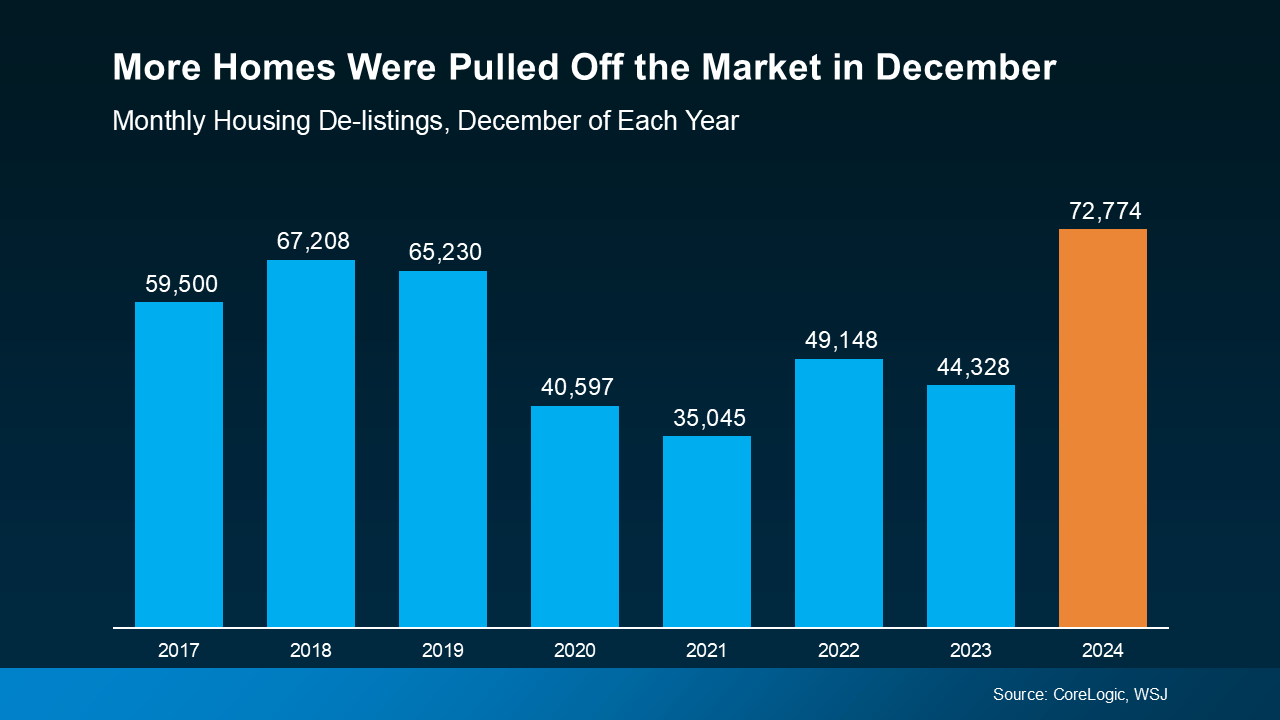
If you took your house off the market in late 2024, you’re not the only one. Newsweek reports that data from CoreLogic and the Wall Street Journal (WSJ) says nearly 73,000 homes were pulled from the market in December alone – that's more than any other December going all the way back to 2017 (see graph below):

a graph of blue bars with numbersWhether it was because offers weren’t coming in, the timing around the holidays felt overwhelming, or they wanted to see if the market would improve in the new year – a lot of other homeowners decided to press pause, too.

But now, with spring fast approaching, it’s time to reassess. The market is already picking up, and waiting any longer to jump back in may only mean you’d face more competition from other sellers down the road.

Why Now Could Be the Right Time 

Selma Hepp, Chief Economist at CoreLogic, explains that some of those sellers may have pulled their listings late last year with the goal of trying again this spring: 

“Another reason for a step back could be that sellers wanted to wait and see how spring home buying season goes, and if mortgage rates fall, which would bring more home buyers and competition back in the market.”

That’s because spring is when buyer demand is typically at its highest point for the year. More people start their home search once the weather warms up. They’re eager to close on a home so they can move in during the summer. So, it’s a great window for sellers. It means more buyers.

And while mortgage rates haven’t fallen dramatically, they have come down some in recent weeks. Early signs already show buyers are becoming more active as a result. Since January, demand has picked up – and that should continue as spring draws even closer.

What To Do Differently This Time

Start by checking the status of your listing agreement. Because even if you pulled your listing, you may still be under contract. And until your listing expires, your agent or brokerage is your best resource on what else you could try to get it sold. Realtor.com offers this advice:

“If you aren't sure of the status of your listing, whether active, expired, or withdrawn, take a look at your listing agreement and talk to your real estate agent.”

If your contract is still active, now’s the perfect time to reconnect with your agent to explore strategies to get your home sold this time around. If your contract has expired and you’re considering other options, reach out to a trusted real estate professional who can help you figure out where to go from here.

Either way, take some time to reflect on your last experience. What held you back from getting it sold before? And what can you do to improve your chances this time around? 

Be sure to include your agent in this thought process. They’ll give you an objective point of view and some advice based on what may have gone wrong last time, like: 

  • Your Pricing Strategy: Did buyers overlook your house because it was priced too high? Your real estate agent can help you analyze the latest sales in your area to make sure you’re hitting the right number. Believe it or not, you could actually be leaving money on the table by not pricing competitively. When it’s priced appropriately for the market, your opportunities for multiple offers and buyer competition increase.
  • Your Marketing Approach: Was your home staged to look its best? Did you use a skilled photographer for your listing photos? Small tweaks can make a big difference in how buyers see your house. Something as simple as taking new photos now that it’s spring can help your house show better than it did in the winter listing.
  • Offering Concessions: Were you willing to offer incentives to buyers? As the supply of homes for sale grows, more sellers are entertaining the idea of concessions or incentives to get the deal done. If you weren’t open to those conversations, that may have been a factor, too.
  • Showings and Flexibility: Did you have limits on when buyers could see the home? If your house is accessible and available, you’ll likely get more offers.  

Bottom Line

If your house didn’t sell last year, spring may be your second chance. With buyer activity rising, it’s the perfect time to talk to an agent about coming back into the market with a fresh strategy. 

What do you want to do differently this time around? Talk to us here at the Expert Real Estate Team to go over your options and make a plan.

Posted in Selling
March 13, 2025

5 Things You Need to Know About the 2025 Spring Housing Market

The spring housing market is here, and if you’re thinking about buying or selling, you’ve probably heard plenty of predictions, opinions, and advice. Some of it is useful. Some of it, not so much.

So, what’s the real story? Realtor.com’s Chief Economist, Danielle Hale, recently shared advice with her own neighbor about buying a home—advice that every buyer and seller needs to hear.

Here’s what you actually need to know about the 2025 spring market, based on data from Zillow and expert insights from Hale herself.

1. Timing the Market? That’s a Risky Game

Zillow’s latest research says that homes listed in late May sell for $5,600 more on average. That stat makes headlines every year, but here’s what most people miss:

  • In 2022, March was the best month to sell.
  • In 2023, it was June.
  • In 2025? No one knows for sure, because mortgage rates, local demand, and inventory play a bigger role than the calendar.

Danielle Hale backed this up when giving advice to her neighbor:

“There are always reasons to be uncertain in the housing market. My advice…is to keep your eyes open and when you see the home that is a good fit to go for it.”

Trying to outsmart the housing market is like trying to predict the stock market—it rarely works.

2. Serious Buyers Are Always Looking

A common myth is that most buyers don’t start house hunting until late spring. In reality, serious buyers are already looking.

Mortgage rate volatility means that buyers are jumping in and out of the market all year long. They’re not waiting for May—they’re waiting for an opportunity.

The takeaway? If you’re selling, don’t assume waiting for May will bring better buyers. The right buyer could be searching for your home right now.

3. Mortgage Rates Matter More Than the Season

This is the real wild card. If rates drop, buyers flood the market—no matter the time of year. If rates rise, demand cools off—even in a so-called “hot” market.

That’s why Hale told her neighbor to stop worrying about short-term fluctuations and instead focus on long-term plans. If you plan to stay in a home for at least five years, trying to time the market perfectly isn’t worth the stress.

For sellers, this means one thing: If buyers see an opportunity, they’ll jump—regardless of whether it’s May, March, or July. The question isn’t when you list; it’s how competitive you make your home.

4. Local Insights Matter Most

One of the biggest mistakes buyers and sellers make is trusting national headlines instead of understanding their local market.

Zillow found that the best time to sell varies widely by city. In San Diego and Austin, the peak selling period starts as early as March. In Phoenix, sellers don’t hit peak pricing until November, and in Orlando, the “seasonal bump” is small—just 0.9%. 

Meanwhile, inventory is rising in some areas and staying tight in others. The Northeast is still short on homes. The South and West have more new construction, which means more options for buyers.

Danielle Hale summed it up perfectly: 

“You want to look at national numbers to understand the broader context, but what really matters is what’s happening in your market.”

So what’s happening in the Greenville market? Here are some quick housing market stats:

  • Inventory: Down 2.4% year over year. 
  • Median Sale Price: Down 2.1% year over year. The median price is $305,000. 
  • Days on Market: Homes sold in 61 days in February, on average.

Want a deeper dive into market stats for your neighborhood? Contact a professional at 864-895-9791, and we will compile the data for you. 

5. The Right Listing Strategy Can Make or Break Your Sale Price

A lot of sellers focus on when to list. But how you list is just as important—maybe more.

Zillow’s research found that:

  • Homes listed on the MLS sell for 1.5% more than off-market listings.
  • Homes with high-quality photos, 3D tours, and interactive floor plans sell for 2% more.
  • Homes with in-demand features—like remodeled interiors, outdoor TVs, or bluestone patios—can command thousands more in offers.

That’s why sellers who maximize exposure and highlight the right features will get top dollar—no matter the month.

Final Thoughts

The biggest takeaway from both Zillow’s research and Hale’s advice is that you shouldn’t wait around for the “perfect” moment.

For buyers: If you find a home that meets your needs and budget—and you plan to stay put for a while—go for it.

For sellers: If you’re ready to sell, focus on strategy, not just timing.

The market doesn’t wait for anyone, and the best deals go to those who are prepared to act.