


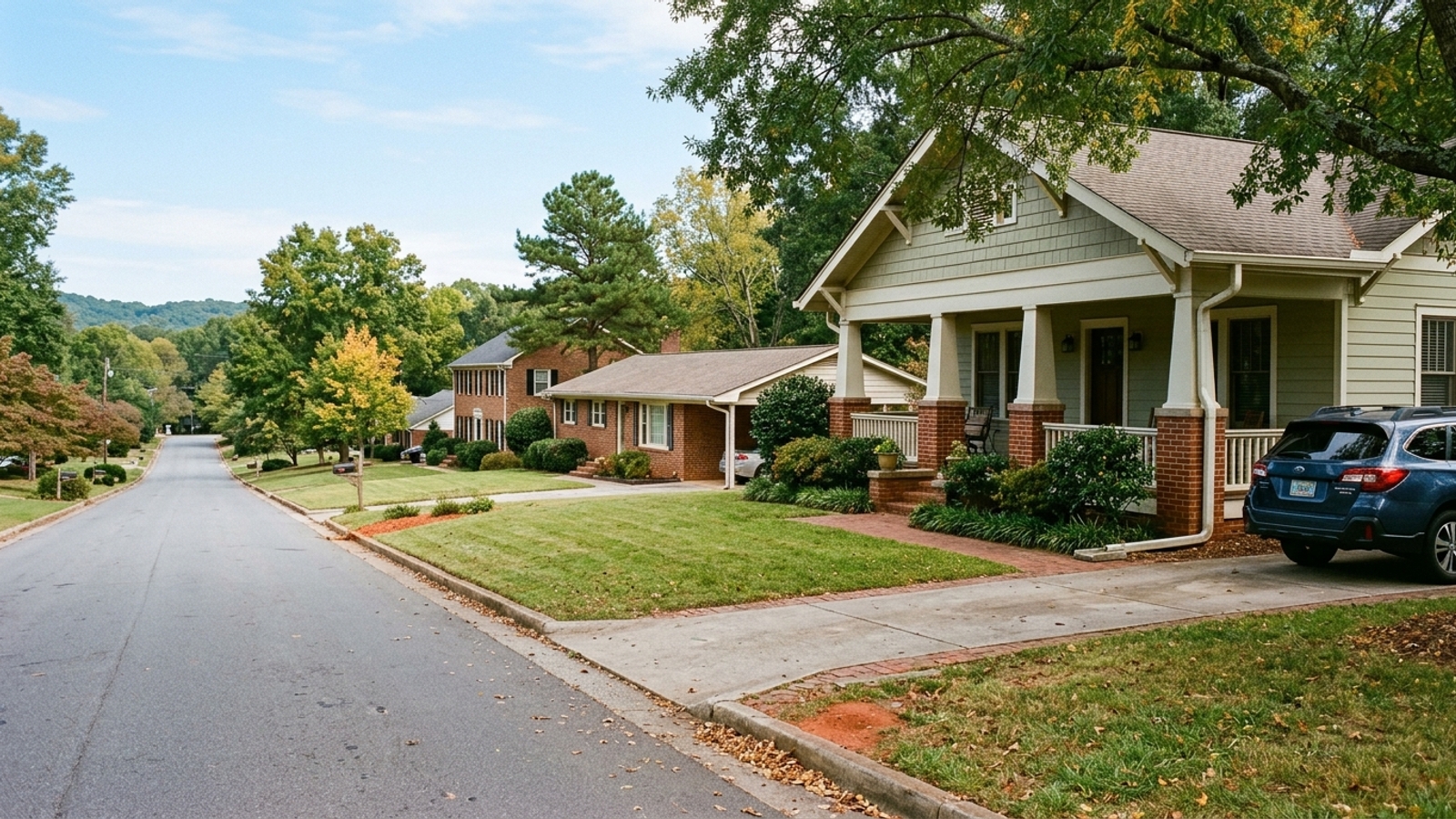
Greenville County sits in the Blue Ridge foothills, which gives it distinct seasons that shape how houses are built and maintained. The local climate dictates everything from how your HVAC system handles summer moisture to how your roof holds up when freezing rain rolls through.
The right lot and inspection focus depend on the specific hazards the climate presents: freezing rain in winter, heavy clay soil that resists drainage, and tropical-storm remnants that push wind and flooding inland. A home that handles the weather patterns in Greenville, SC, well will save you thousands in repairs and utility costs over the years.
Key takeaway
Greenville has a humid subtropical climate with hot, sticky summers and short winters where freezing rain, not snow, is the hazard that matters most. For a house, that means moisture management, HVAC performance, and trees near the roof are the things worth inspecting. In the 90 days ending September 30, 2026, Greenville homes sold for a median 97.2% of list price, which leaves room to negotiate repairs. If you'd rather not own roof and yard storm exposure, a condo or townhouse can shift much of it to an HOA, provided you confirm exactly what the association covers.
Who this guide is for
You're considering a move to or a home purchase in Greenville and want to know what the climate will mean day to day and for the house you choose.
What are the weather patterns in Greenville, SC?
Greenville County is classified as Climate Zone 3, Mixed-Humid by the Department of Energy. The city sits at an elevation of 955 feet, which gives it a milder summer profile than the South Carolina coast while keeping it firmly in a humid subtropical pattern.
The real weather risks for a homeowner here are year-round humidity, winter freezing rain landing on mature trees, and tropical-storm remnants pushing inland. You'll spend more time managing moisture and runoff than worrying about deep snow or record-breaking heat.
If you want to weigh these environmental factors against the area's economic and cultural traits, the pros and cons of living in Greenville is worth reading. This guide focuses strictly on how the local climate helps you pick a home type, evaluate a lot, and know what to inspect. One honest caveat: climate averages hide yearly variability. A statistically mild winter can still deliver a damaging ice event.
Greenville weather by season
National Weather Service daily climatological normals put average annual precipitation for the Greenville-Spartanburg area at 49.67 inches. That rain isn't evenly distributed across the calendar.
Spring brings heavy pollen and the start of severe thunderstorm season. Summer means long, humid stretches with frequent afternoon thunderstorms that test your roof and drainage, and you'll run your air conditioning for months, making energy efficiency a real factor in what you pay each month. Fall is the driest season based on climate normals, the most comfortable stretch of the year and the easiest time for outdoor work, moving, and getting a feel for outdoor activities. Winter is relatively short but brings the distinct threat of freezing rain rather than predictable snow. The catch is that the pleasant shoulder seasons of spring and fall overlap directly with severe-storm and tropical-remnant season, so comfortable doesn't mean calm.
How humidity and rain affect Greenville homes
The Greenville soil series, which is extensive in the county, consists of well-drained soils formed in marine sediments with a subsoil containing 35 to 55 percent clay. Heavy clay means water doesn't absorb quickly during heavy downpours, and that runoff puts real pressure on gutters, downspouts, and lot grading to move water away from the foundation.
High humidity and heavy rain combine to create moisture risks in crawlspaces. Wood rot and mold follow if the space isn't properly ventilated or sealed.
Ask the seller whether the crawlspace has a vapor barrier, dehumidifier, or sump pump, and have your inspector check for moisture and wood rot. Get the HVAC system's age and service records, and test the AC during a warm showing to confirm it's sized correctly for dehumidification. The different types of homes and construction styles show how older and newer builds handle moisture differently.
The uncomfortable truth: crawlspace and drainage problems are often invisible at a showing and can run into thousands of dollars. They need to surface during your inspection period, not after closing.
Winter ice and storms in Greenville
The South Carolina State Climatology Office recorded 183 total winter weather-related events for Greenville County, including 11 ice storms. Damaging winter weather here tends to be freezing rain and ice accumulation, which brings down limbs and power lines rather than burying roads in snow. A severe ice storm in December 2005 left more than three-quarters of an inch of ice across parts of the Upstate. An ice storm in January 2026 brought 0.29 inches of freezing rain to the Greenville-Spartanburg airport.
Mature trees over a roof or driveway raise your property damage risk considerably. An arborist visit before you buy is worth the cost. Overhead power drops mean outages are common during these freezes, and pipes in crawlspaces and exterior walls can freeze during cold snaps.
Ask the seller about past power outages and whether the home has a generator inlet or transfer switch. Have an arborist assess large trees near the roof, driveway, and power drop before your inspection period ends. The irony isn't lost on anyone: the dense tree canopy that makes older Greenville streets so appealing is exactly the feature that fails under heavy ice.
Severe storms, tornadoes and tropical remnants
Between 1950 and 2020, Greenville County recorded 37 tornadoes, resulting in zero fatalities, 24 injuries, and $11.7 million in total damage costs. The strongest were F3 events in 1952 and 1973.
Tropical remnants that make landfall hundreds of miles away frequently push wind and flooding inland to the Upstate. During Hurricane Helene in September 2024, a predecessor event dropped up to 10 inches of rain in the mountains before the main storm brought widespread wind damage and power outages to the area. At the Greenville-Spartanburg International Airport, Helene produced sustained winds of 38 knots with gusts up to 59 knots, and local reporting indicated four deaths in the county.
Greenville County has an estimated 33,738 acres within the 100-year floodplain and 1,914 acres within the 500-year floodplain. Look up any property address on the FEMA Flood Map Service Center and ask the seller about past water intrusion. Unincorporated county residents receive a 15% discount on flood insurance through the NFIP Community Rating System. Ask your insurer about wind and hail deductibles too. A property outside a mapped flood zone can still take water from heavy rain.
What Greenville's weather means for buying a home
In the 90 days ending September 30, 2026, homes across Greenville took a median of 71 days to sell, with inventory sitting at 5.3 months of supply. That pace gives you time to schedule inspections, hire an arborist, and submit repair requests rather than rushing an offer.
Single-family homes are the exception, with 12.2% selling above list price. Expect less room to negotiate on a well-kept house with a newer HVAC system. Townhouses had 7.9 months of supply and none sold above list, so you have real negotiating room there even though median prices rose. Condos took a median 97 days to sell, making them the slowest-moving property type on the market.
Condos and townhouses can shift roof, exterior, and tree upkeep to an HOA. Ask the association in writing which storm damage it covers and how reserves are funded before you commit. You can review broader Greenville housing market trends to see how these figures fit into the full year, or read about selling a home in Greenville if you're timing a listing around the weather.
The slow market gives you room on price, but it doesn't make storm or moisture risk disappear. Negotiate the fix, not just a discount.
Questions to narrow your Greenville home search
Do you want to own the roof, gutters, and yard yourself, or share that upkeep through an HOA? The section on what Greenville's weather means for buying a home compares how single-family homes, townhouses, and condos are selling right now.
Is the lot wooded with large trees near the house or power drop? Read the winter ice and storms section before you make an offer.
Is the home built on a crawlspace, or does it sit near a creek or the Reedy River? Start with how humidity and rain affect homes and run the flood-map check mentioned in the severe storms section.
Are you trying to close before winter? The buying section explains how the summer-quarter pace gives you time for inspections and an arborist. For more steps on starting your search, check our moving to Greenville guide or browse current homes for sale.
At a glance
- All homes, 90 days ending 2026-09-30: median sale price $492,266, down 8.8% year over year (245 sales)
- All homes, 90 days ending 2026-09-30: median 71 days on market, 97.2% sale-to-list, 8.7% sold above list
- All homes, 90 days ending 2026-09-30: 5.3 months of supply, 425 homes in inventory, median $315 per square foot
- Single family, 90 days ending 2026-09-30: median sale price $543,783, down 13.4% year over year (167 sales)
- Single family, 90 days ending 2026-09-30: median 64 days on market, 97.5% sale-to-list, 12.2% sold above list, 4.7 months of supply, median $324 per square foot
- Townhouse, 90 days ending 2026-09-30: median sale price $452,505, up 5.5% year over year (35 sales)
- Townhouse, 90 days ending 2026-09-30: median 89 days on market, 96.9% sale-to-list, 0% sold above list, 7.9 months of supply, median $247 per square foot
- Condo, 90 days ending 2026-09-30: median sale price $359,963, down 1.4% year over year (42 sales)
- Condo, 90 days ending 2026-09-30: median 97 days on market, 96% sale-to-list, 2.4% sold above list, 5.4 months of supply, median $315 per square foot
Greenville, SC weather FAQs
What is the average snowfall in Greenville, South Carolina?
Snow totals swing widely by year in the Upstate, with many winters seeing little or none. Check the National Weather Service Greenville-Spartanburg office for historical snowfall data. You'll face freezing rain and ice accumulation far more often than deep snow.
Is Greenville, SC expected to get snow this winter?
Seasonal outlooks give probabilities for temperature and precipitation, not specific snow totals. Check the NOAA Climate Prediction Center for the current winter outlook in the Southeast. Follow local National Weather Service forecasts as individual winter storms approach.
What is the coldest month in Greenville, SC?
January is the coldest month in Greenville. According to NOAA climate normals from 1991 to 2020, January at Greenville-Spartanburg averages a high of 52.6°F and a low of 32.7°F. Protect exposed pipes in crawlspaces and exterior walls during winter cold snaps.
Does it rain a lot in Greenville, SC?
The Greenville-Spartanburg area receives an average annual precipitation of 49.67 inches based on NOAA 1991-2020 climate normals. Fall is typically the driest season of the year. Heavy downpours are common during summer afternoon thunderstorms and passing tropical remnants.
Is Greenville, SC as humid as Florida?
Greenville is humid in the summer, but it generally has a shorter muggy season and cooler nights than most of Florida. Check NOAA climate data to compare the normal summer dew points between Greenville-Spartanburg and Florida cities like Orlando or Miami.
What was the hottest day in Greenville, SC?
The all-time record high temperature for the Greenville-Spartanburg International Airport station is 107°F. This record was set in July, based on extremes recorded from 1884 to the present.
Is Greenville, SC in a drought?
Drought status changes week to week. According to the US Drought Monitor, there is currently no drought in Greenville County, and drought development is not predicted for the area at this time. Look at the current Drought Monitor map for South Carolina on the date you read this.
Where in South Carolina has the best weather?
The best weather depends on your preferences for heat and winter cold. The Upstate's elevation gives it slightly milder summer heat than the Midlands, while the coast has warmer winters but more hurricane exposure. For comparison, January in Charleston averages a high of 60.2°F and a low of 38.9°F based on NOAA normals.
Sources
- Redfin: Data Center
- National Weather Service: Greenville-Spartanburg Climate Normals
- Wikipedia: Greenville, South Carolina weatherbox
- NOAA: Monthly Normals 1991-2020
- National Integrated Drought Information System: Greenville County
- South Carolina State Climatology Office: Greenville County Climate Data
- National Weather Service: Hurricane Helene Summary
- South Carolina Office of Resilience: Early Notice and Public Review
- Department of Energy: Building America Climate Guide
- USGS: Geographic Names Information System
- USDA-NRCS: Official Series Description