


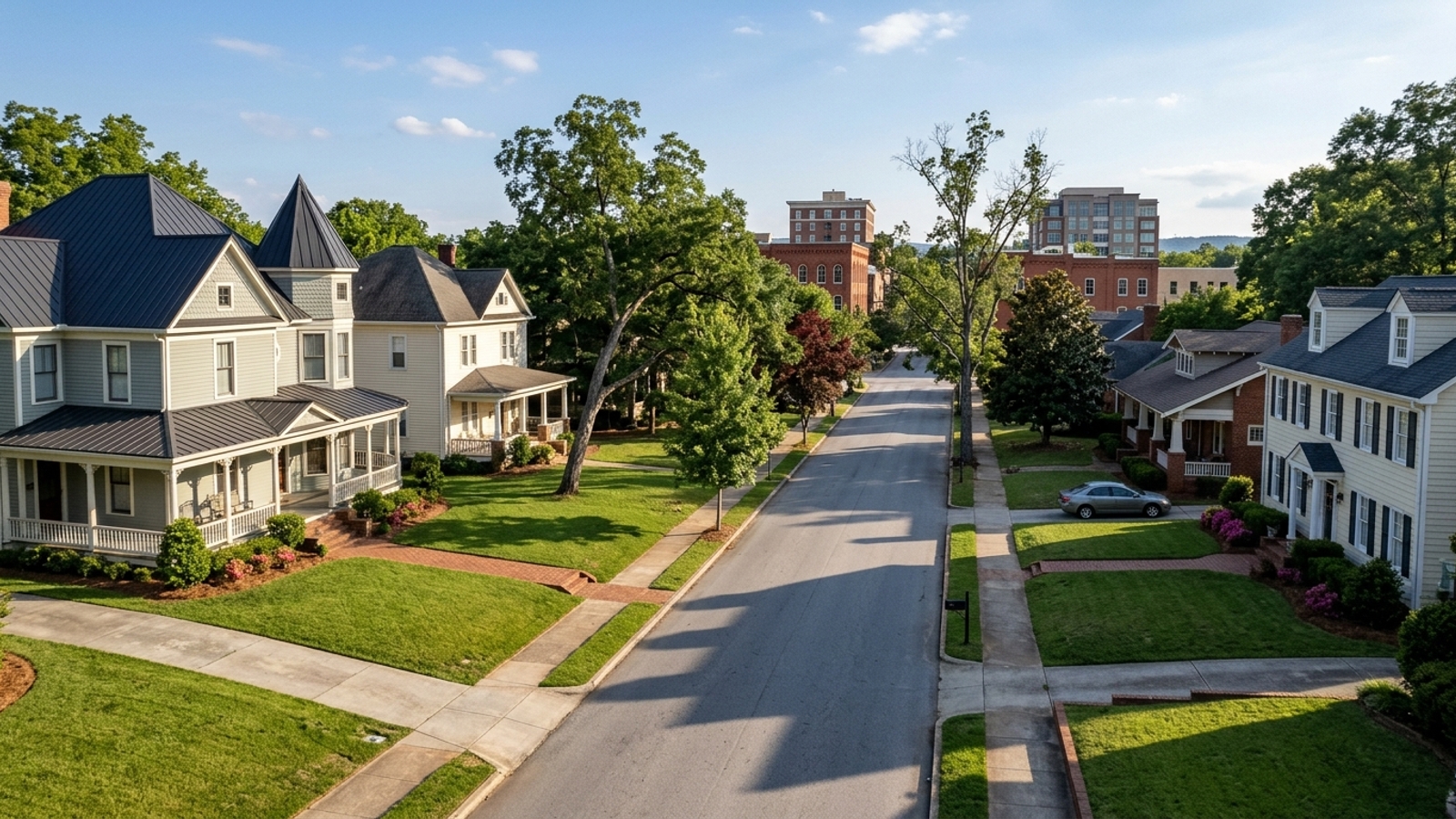
Greenville, SC offers multiple paths for a retirement move, from continuing care campuses to low-maintenance townhouses on the open market. Trading a larger house for an attached property gives homeowners a chance to cash out equity and downsize without leaving the area.
Key takeaway
If you want assisted living and nursing care available on one campus, start with Greenville's continuing care communities such as Cascades Verdae and Rolling Green Village, which charge an entrance fee plus a monthly fee. If you don't need care yet, buying a townhouse or condo on the open market is the better deal right now. Townhouses had 7.9 months of supply in the 90 days ending Sept. 30, 2026, which leaves buyers room to negotiate.
Who this guide is for
You're planning a retirement move in or around Greenville and deciding between a community that includes care and a smaller home you buy and run yourself.
Types of retirement communities in Greenville
If you don't need care on site yet, Greenville's low-maintenance housing is a buyer's market and the cheaper way into retirement. On top of that deep inventory, 0% of townhouses sold above list price in the 90 days ending Sept. 30, 2026. Condos took a median 97 days to sell.
That inventory position lets you negotiate a downsize and keep the equity a continuing care entrance fee would absorb. Price the buy-it-yourself path before you sign a continuing care contract.
Continuing care retirement communities (CCRCs)
These properties put independent living, assisted living, memory care and skilled nursing on one campus. You pay an entrance fee plus a monthly fee. A contract, rather than a deed, defines what you get.
South Carolina's State Continuing Care Retirement Community Act requires every CCRC to hold a license from the Department of Consumer Affairs before it operates, advertises, or collects a reservation deposit or entrance fee. The Department issues a final license only if it finds two things:
- People: the persons responsible are competent and trustworthy.
- Finances: the community is financially responsible and can meet its obligations to residents.
This is the largest up-front cost of the three paths. You typically own no real estate, so your money is governed by the contract's refund terms.
55+ active-adult neighborhoods
You buy and own a home in an age-restricted neighborhood where a homeowners association handles common areas and amenities. No care is provided on site.
These neighborhoods must meet the federal 55+ occupancy rule. If you later need daily care, you'll have to move again. The age restriction also narrows your buyer pool when you sell, so read the recorded covenants before you make an offer.
Condos and townhouses with no age rule
You can buy a smaller, lower-upkeep home on the open market with no entrance fee and no age verification. No care, meals or built-in activities come with the home, so you arrange help, transport and social life yourself.
How to choose a retirement option in Greenville
Your timeline for needing care and how you want to use your home equity drive the decision.
- Do you want guaranteed access to assisted living and nursing care without moving again? If yes, read the continuing care profiles and the entrance-fee section first. If not, skip to low-maintenance homes to buy.
- Would you rather turn home equity into an entrance fee, or keep that money invested and liquid? The equity example under downsizing shows how much a single-family sale frees up at Greenville medians.
- Are stairs a problem now or likely to be within a few years? If so, start with condos and single-level houses, not townhouses.
- Do you want an age-restricted neighborhood, or no limits on who can buy your home when you sell? Compare the 55+ neighborhoods section with the open-market condo and townhouse section.
Continuing care retirement communities in Greenville
Greenville County has several continuing care campuses that offer independent living alongside higher levels of medical support. Before you put down a deposit, request each community's South Carolina disclosure statement and its most recent audited financial statements. Ask what care needs would trigger a move from independent to assisted living, and who makes that call.
Cascades Verdae
Cascades Verdae is a continuing care retirement community in Greenville, SC that offers a continuum of care centered through Linville Court. Its own page lists these services:
- Independent Living and Independent Living Plus
- Assisted Living
- Memory Care
- Skilled Nursing
- Respite Care
- Short-Term Rehabilitation
Its main page publishes no entrance or monthly fees. You can't compare the cost until you request the fee schedule and disclosure statement from the sales office.
Rolling Green Village
Rolling Green Village is a Life Plan Community offering Independent Living, Assisted Living, Memory Care and Skilled Nursing. As of a recent cottage pricing page, entrance fees for independent living cottages begin at $347,715, with monthly fees starting at $5,598 a month.
It uses a Type C (Fee-for-Service) contract. Residents pay for additional care only as needed rather than bundling it into the entrance fee, so your monthly cost rises when you move to assisted living or nursing care. Cost predictability is what you give up.
The Woodlands at Furman
The Woodlands at Furman is a nonprofit Life Plan Community adjacent to Furman University. It offers a Life Care contract guaranteeing Independent Living and continuing care on site, including Assisted Living, Memory Care and Skilled Nursing.
Its north-county campus can add real distance to downtown appointments.
What continuing care and senior living cost in Greenville
South Carolina law requires operators to give prospective residents a disclosure statement by the time a contract is signed or money or property is transferred, whichever comes first. Ask each community for its current entrance-fee schedule, refund percentage and contract types.
Entrance fees and contract types
The South Carolina Department of Consumer Affairs identifies three common CCRC contract types:
- Extensive agreements (Type A): unlimited specified health-related services with little or no increase in monthly payments.
- Modified agreements (Type B): a set amount of care.
- Fee-for-Service agreements (Type C): you pay for care only as you use it.
State law requires a continuing care contract to state clearly what portion, if any, of the entrance fee is refundable and nonrefundable. A higher refund percentage generally means a higher entrance fee, which leaves less equity for your heirs or other uses. Refunds are often paid only after your unit is resold, so ask how long the community's refunds have taken to pay out after a resident leaves or dies.
Monthly fees and what they cover
Ask exactly which meals, utilities, housekeeping services, transportation options and care hours the monthly fee includes, and how it changes when you move to a higher level of care. Monthly fees rise over time, so ask for the community's increase history for the past five years. Because the fee replaces some everyday Greenville cost of living expenses, compare it with what you now spend on utilities, food and upkeep.
Rental independent and assisted living
Renting in an independent or assisted living community means a month-to-month or lease-based agreement with no large entrance fee. Your savings stay liquid to pay for care as you need it.
Renting does not guarantee a nursing bed later, and if your care needs exceed what the community is licensed to provide, you'll have to move.
Low-maintenance homes to buy in Greenville
Buying a smaller home on the open market avoids entrance fees and gives you full ownership of your real estate. Prices are moving in different directions by property type, so judge housing market trends by the segment you'd buy in, not the overall median.
Townhouses
Townhouses offer the most space for the money. In the 90 days ending Sept. 30, 2026, Greenville townhouses sold at a median $247 per square foot against $315 for condos (based on 35 townhouse sales). At those median rates, every 1,000 square feet costs about $68,000 less as a townhouse than as a condo.
Given that inventory and the absence of over-list sales, there's little reason to offer full asking price. The savings leave room for a guest bedroom or home office without paying condo premiums.
Most townhouses are multi-story. Walk each floor plan for a main-level primary bedroom and full bath, or plan on climbing stairs daily.
Condos
Condos provide one-level living and the easiest negotiating environment. In the same 90 days, condos sold at a median 96% of list price, and only 2.4% went above list (based on 42 condo sales). Offers below asking are normal in this segment, and seller concessions are worth asking for.
HOA dues and special assessments can erase the purchase discount. Ask the HOA for:
- current dues and what they cover
- the latest reserve study
- any pending special assessments
If a future buyer might need FHA financing, check whether the complex is FHA-approved on HUD's condominium approval lookup.
Single-level single-family homes
Single-level houses offer the most room and no HOA layer. They're also the property type with the steepest recent price drop: the single-family median fell 13.4% year over year.
Even so, 12.2% of single-family homes sold above list price in the 90 days ending Sept. 30, 2026. Well-kept ranch houses with no entry steps are the ones that draw competing offers. You keep the roof, yard and exterior upkeep.
Downsizing from a Greenville house
Your sale timing and the state's tax breaks decide how much equity you keep. When selling a home in Greenville, pricing and preparing it well sets how fast you reach the closing that funds your next purchase.
Selling first or buying first
Single-family homes sold in a median 64 days in the 90 days ending Sept. 30, 2026, while condos and townhouses sat longer. That means you can often sell first, buy from a well-stocked attached-home market, and make an offer that a slow-selling condo or townhouse seller is more likely to accept.
Selling first can leave a gap between closings. Ask the buyer for a rent-back period, or plan a short-term rental before you list.
Equity at Greenville medians
Selling a single-family home at the $543,783 median and buying a condo at the $359,963 median frees about $183,820. Buying a townhouse at the $452,505 median frees about $91,278.
Both figures are before real estate commissions, moving costs and South Carolina's deed recording fee. That fee is $1.85 for each $500 of value, or $3.70 per $1,000, per the SC Department of Revenue. Once you have a fee schedule in hand, compare the remaining cash with a CCRC entrance fee.
Medians aren't your house, and your exact figure depends on your property's condition and location.
Property tax relief at 65
In Greenville County, the Homestead Exemption exempts taxes on the first $50,000 in Taxable Market Value of a legal residence for homeowners 65 or older. Applicants must have been a legal SC resident for one calendar year as of December 31 preceding the tax year. You apply through Greenville County Real Property Services.
Under state law, an owner-occupied legal residence is taxed on an assessment equal to 4% of fair market value, compared with the standard 6% ratio for non-owner-occupied property.
Neither break is automatic, so you have to apply after you buy. A continuing care resident who owns no real estate generally has no homestead to exempt.
Is Greenville a good place to retire?
For the wider picture, weigh the pros and cons of living in Greenville. If you're moving to Greenville from another state, line up in-network doctors before you close.
Healthcare access
Prisma Health Greenville Memorial Hospital is the region's referral center and Level 1 Adult Trauma Center for Upstate South Carolina. Bon Secours operates two hospital campuses in the city, St. Francis Downtown and St. Francis Eastside.
Compare drive times from these hospitals to each community on your shortlist. Proximity doesn't mean you're in-network, so check that your doctors and Medicare plan network include the system nearest the community you choose.
State taxes on retirement income
South Carolina does not tax Social Security benefits. You may deduct up to $3,000 of qualifying retirement income a year until age 65, and up to $10,000 a year from 65 on.
A resident 65 or older by year-end can also claim a deduction of up to $15,000 against any South Carolina taxable income. That cap is reduced dollar-for-dollar by any retirement income deduction you claim, so the combined total can't exceed it.
Pension or IRA income above the cap is taxed. Confirm your own numbers with a tax professional.
At a glance
- Single-family median sale price: $543,783, down 13.4% year over year (167 sales, 90 days ending Sept. 30, 2026)
- Single-family: median 64 days on market, 97.5% sale-to-list, 12.2% sold above list, 4.7 months of supply, $324 median per sq ft (90 days ending Sept. 30, 2026)
- Condo median sale price: $359,963, down 1.4% year over year (42 sales, 90 days ending Sept. 30, 2026)
- Condo: median 97 days on market, 96% sale-to-list, 2.4% sold above list, 5.4 months of supply, 73 listings, $315 median per sq ft (90 days ending Sept. 30, 2026)
- Townhouse median sale price: $452,505, up 5.5% year over year (35 sales, 90 days ending Sept. 30, 2026)
- Townhouse: median 89 days on market, 96.9% sale-to-list, 0% sold above list, 7.9 months of supply, 89 listings, $247 median per sq ft (90 days ending Sept. 30, 2026)
- All homes: median sale price $492,266 (down 8.8% year over year), 71 median days on market, 5.3 months of supply, 425 listings (245 sales, 90 days ending Sept. 30, 2026)
Greenville, SC retirement communities FAQs
What is the 80/20 rule in a 55+ community?
Under HUD's HOPA regulations, at least 80 percent of a community's occupied units must be occupied by at least one person 55 or older, and the community must follow HUD's age-verification rules. Each community's covenants set who may live in the remaining 20%.
Is it cheaper to live in a 55 and over community in Greenville?
It depends on the neighborhood. Compare its HOA dues and what they cover, such as exterior upkeep and clubhouse access, against an open-market condo's dues.
Is it cheaper to retire in Greenville, SC or Florida?
It depends on your income mix and insurance costs. Florida has no state income tax, while South Carolina exempts Social Security and offers the age-65 deduction described above. Compare your tax bill and insurance quotes in both states.
Are there 55+ communities near Greenville, SC?
Yes. Greenville County has age-restricted neighborhoods that qualify as housing for older persons. Confirm each one's restriction in its recorded covenants.
Will Medicare cover an assisted living stay in Greenville?
No. Medicare doesn't cover long-term custodial care, so room, board and personal care in assisted living aren't covered. South Carolina's Community Choices waiver can help eligible residents pay for assistive services in a residential care facility, but not for room and board.
Is it better to rent or buy in a 55+ community?
Renting avoids a down payment and resale risk. Buying builds equity but ties your resale to age-qualified buyers, so ask whether owners may rent out units and request current lease terms to compare costs.
Is there a waitlist for retirement communities in Greenville?
Waitlists vary by property and time of year. Ask each community for the current wait by unit type, the deposit amount, and whether the deposit is refundable or applied to the entrance fee.
Who regulates continuing care retirement communities in South Carolina?
The South Carolina Department of Consumer Affairs licenses them and charges a $2,000 filing fee for applications.
Sources
- Redfin: Data Center
- Cascades Verdae: Care Services
- Rolling Green Village: Cost of Living at Rolling Green Village
- The Woodlands at Furman: Home
- South Carolina Legislature: Title 37, Chapter 11
- Code of Federal Regulations: Title 24, Part 100, Subpart E
- Medicare.gov: Long-Term Care
- South Carolina Legislature: Title 12, Chapter 43
- South Carolina Department of Revenue: Individual Income Tax FAQ
- South Carolina Department of Revenue: Deed Recording Fee
- Bon Secours: Hospitals and Medical Centers in Greenville