


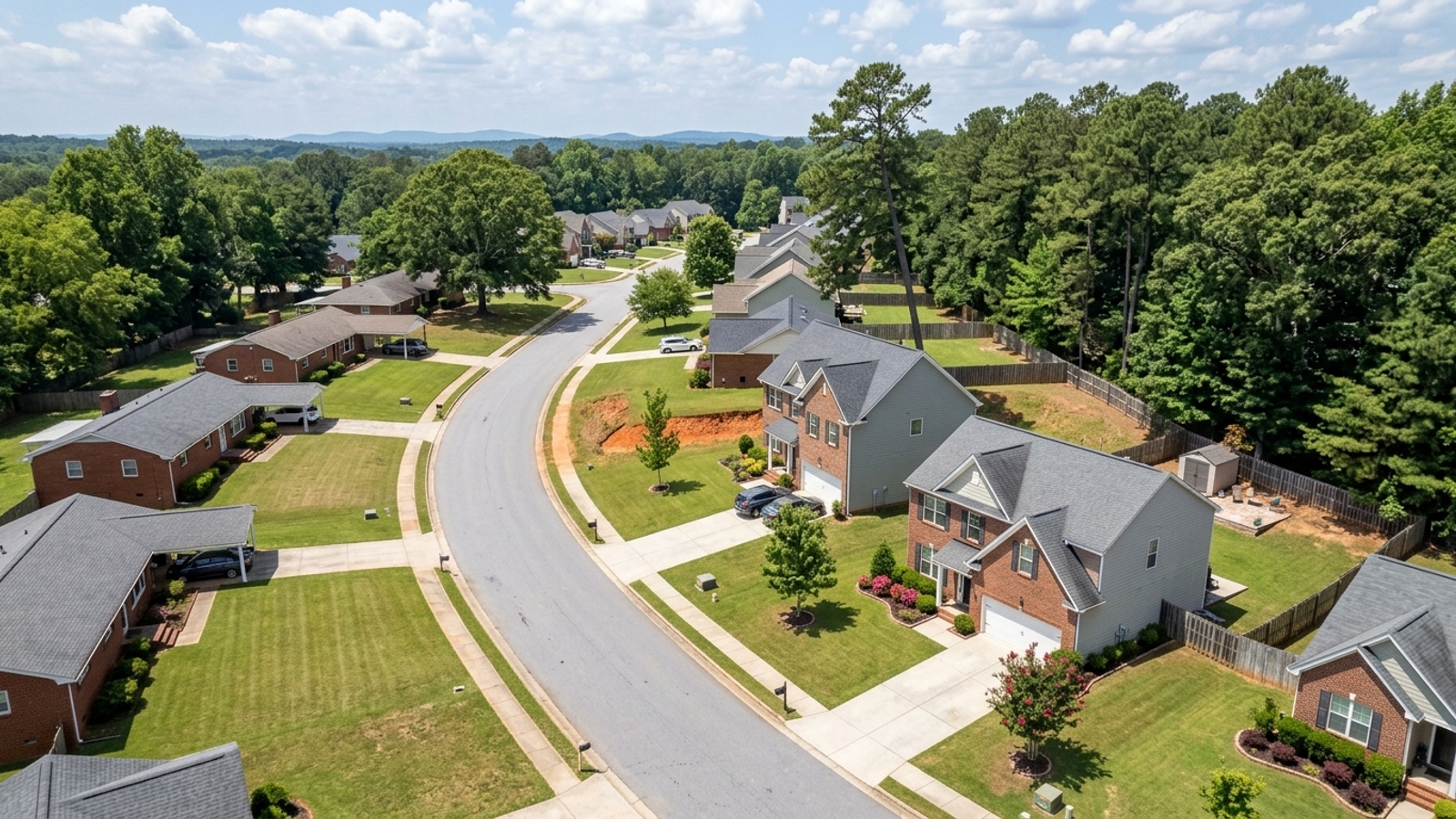
Buyers comparing South Carolina's major hubs often look at the Upstate and the Lowcountry. Housing costs, property types, and insurance differences separate Greenville, SC, and Charleston.
A quick look at citywide medians hides the real market dynamics. Townhouses, condos, and single-family homes perform differently, giving you a clearer picture of what your budget buys in 2026.
Key takeaway
If what your money buys decides it, start in Greenville, and look first at townhouses. With 7.9 months of supply, buyers there set more of the terms. Charleston is the alternative if living near the coast matters more than space per dollar, as long as you price in coastal insurance and flood-zone costs before comparing.
Who this guide is for
You're deciding between buying in Greenville or Charleston and want to see what your budget and monthly ownership costs look like in each before you commit to one search.
Greenville vs Charleston home prices
Compare property types rather than citywide medians, or you'll miss where the real cost difference sits.
In Greenville, the headline price drop and the buyer's bargaining power don't land in the same place. Single-family medians dropped sharply year over year, yet those homes still sell fastest at a median 64 days, with 12.2% going over asking. Greenville townhouses, on the other hand, rose in price but sit for a median 89 days on 7.9 months of supply, with none selling above list and the lowest square-foot cost of any property type against $324 for a detached house.
The overall Greenville median sits at $492,266, down 8.8% year over year. Homes are selling under 98% of list price, which means you have room to negotiate. A falling citywide number is useful context, but it's the property-type breakdown that tells you where your negotiating power is.
When you review Charleston figures, confirm they use the same property types and the same 90-day window ending September 30, 2026. Medians shift with the mix of homes sold, which is why grouping Greenville by property type shows where you have an advantage. You can check local housing market trends for more detail on how these numbers move.
Where Greenville buyers have room to negotiate
Different housing types in the Upstate offer different advantages for buyers. Your budget stretches further or shorter depending on whether you want a detached house, a condo, or a townhouse.
The time a property sits on the market dictates how much power you have at the negotiating table. Slower-selling attached homes give you breathing room; single-family houses require faster decisions.
Townhouses and condos in Greenville
Townhouses offer the cheapest square footage in the city, selling at $247 per square foot in the 90 days ending September 30, 2026. That's about a quarter less per square foot than a single-family house, and that holds even though the townhouse median rose recently.
Condos take a median 97 days to sell, based on 42 recent sales. That's enough time to tour twice, read the HOA documents, and still not lose the unit.
The slow pace that gives you time and bargaining room now works against you when you sell. Monthly HOA dues also eat into the price advantage. Ask the HOA for current monthly dues, what they cover, reserve balance, and any planned special assessments. If you're planning FHA financing, check the complex on HUD's FHA condo approval lookup before you make an offer.
Single-family homes in Greenville
The single-family median fell 13.4% year over year, the biggest drop of any property type. Despite that, competition hasn't disappeared: about one house in eight still sells above asking.
The drop is real at the median, but well-priced, well-located houses still draw competing offers. Expect to negotiate on homes that have sat, and to move fast on fresh ones. You can explore the different types of homes available to see what fits your criteria.
Don't read that decline as a price cut you can take off any listing. Part of it reflects which homes happened to sell, not a uniform reduction across everything on the market.
Ownership costs in Greenville vs Charleston
South Carolina regulates hurricane and wind-hail deductibles under state law, requiring insurers to clearly disclose separate percentage-based deductibles. Greenville County is inland and doesn't fall under the state's coastal wind pool area.
In specified coastal portions of Charleston County, standard deductibles for non-named storms sit at 1%, while named-storm deductibles scale from 2% up to 10% of the policy limit with corresponding 15-day to 55-day deductible periods. Get homeowners, wind, and flood insurance quotes on the specific address before comparing monthly costs between the cities. Look up any address on FEMA's Flood Map Service Center and ask the seller for an elevation certificate.
Property taxes shape your monthly payment too. Under South Carolina law, an owner-occupied legal residence qualifies for a special 4% property tax assessment ratio, while non-owner-occupied properties and second homes pay 6%. Ask the county auditor for the millage on the exact parcel, because it varies by city and special district. You can review a local cost of living breakdown for everyday expenses.
Living in Greenville vs Charleston
Greenville sits in the Upstate foothills at an elevation of 984 feet, with Blue Ridge state parks like Table Rock reachable within a short drive from downtown. Charleston sits on the Lowcountry coast, with direct access to the Atlantic Ocean.
That coastal geography brings higher hurricane exposure, which ties directly back to the insurance differences between the two areas. You can weigh these factors alongside the broader pros and cons of living in the area.
Confirm whether a Charleston listing is in the City of Charleston, North Charleston, or the unincorporated county, since taxes and services differ. If you're preparing for a relocation, you can review our guide on moving to the Upstate for local details. You can also explore seasonal things to do in the area once you settle in.
How to decide between Greenville and Charleston
Is daily coastal access worth paying for and insuring? If yes, read the ownership costs section before comparing prices. If no, go straight to the property types where Greenville buyers have room to negotiate.
Do you need a detached house, or would a townhouse or condo work? The answer decides which property type offers you the best terms. If you can't make an offer within days of a listing going live, slower-selling townhouses and condos give you time, while single-family homes may move too fast.
Do you expect to sell again within a few years? The same slow condo market that helps you buy works against you on resale. If you want the best odds of buying below asking, start with Greenville townhouses. If you want a condo around $360,000, start with Greenville condos.
If you want a detached house and you can make offers quickly, start with Greenville single-family homes. If you want to live within a short drive of the beach, Charleston is your choice. Expert Real Estate Team can pull current Greenville townhouse and condo listings and recent sales for a buyer comparing the two cities. You can also read about selling a home in town if you need to list your current property first.
At a glance
- All homes, Greenville: median sale price $492,266, down 8.8% year over year (90 days ending 2026-09-30; 245 sales)
- All homes, Greenville: 71 median days on market, 97.2% sale-to-list, 8.7% sold above list, 5.3 months of supply, 425 homes for sale, $315 median per sq ft (90 days ending 2026-09-30)
- Single family, Greenville: median sale price $543,783, down 13.4% year over year; $324 per sq ft (90 days ending 2026-09-30; 167 sales)
- Single family, Greenville: 64 median days on market, 97.5% sale-to-list, 12.2% sold above list, 4.7 months of supply, 256 for sale (90 days ending 2026-09-30)
- Condo, Greenville: median sale price $359,963, down 1.4% year over year; $315 per sq ft; 97 median days; 96% sale-to-list; 2.4% sold above list; 5.4 months of supply; 73 for sale (90 days ending 2026-09-30; 42 sales)
- Townhouse, Greenville: median sale price $452,505, up 5.5% year over year; $247 per sq ft; 89 median days; 96.9% sale-to-list; 0% sold above list; 7.9 months of supply; 89 for sale (90 days ending 2026-09-30; 35 sales)
Greenville, SC vs Charleston FAQs
Is Greenville or Charleston bigger?
Charleston is larger by population, though city limits and metro areas tell different stories. The Census Bureau estimates Charleston's city population reached 157,665 in July 2024. Greenville's city population was estimated at 75,310 in July 2025.
How far is Greenville, SC from Charleston, SC?
The two cities connect via I-385 and I-26. Check a current routing map for exact driving distances and times from your specific starting address.
What are winters like in Charleston compared with Greenville?
Greenville sees January daily average temperatures around 42 degrees, with typical highs near 53 degrees and lows near 32 degrees. Charleston sits further south on the coast, though official federal monthly-normal comparisons for Charleston International Airport were not located in government sources during this search. Check local weather data for specific Charleston winter averages.
What is the difference between Charleston and North Charleston?
They're separate municipalities with their own governments and boundaries. Confirm which city a listing sits in, because millage and services differ.
Is Greenville, SC in the mountains?
No, Greenville is in the foothills, not the mountains. Downtown Greenville sits at an elevation of 984 feet. You can drive to Blue Ridge state parks from the city.
Is Greenville, SC growing faster than Charleston?
Greenville city saw a 5.9% population increase from its April 2020 estimates base to July 2025. Charleston city saw a 4.7% increase from its April 2020 estimates base to July 2024.
How do crime rates compare in Greenville and Charleston?
Official crime data comes from the FBI's Crime Data Explorer and each city's police department. The Greenville Police Department maintains a Crime Analysis division, and the City of Charleston Police Department publishes an open-data portal with incident maps. Always look up the specific addresses you're considering, compare the same year and offense categories, use rates per 100,000 residents, and avoid mixing city and metro figures.
Is the cost of living lower in Greenville than in Charleston?
Yes, at the metro level. The Greenville-Anderson metro area price level sits about 6.7% below the national average. The Charleston-North Charleston metro area sits about 1.0% above the national average.
Sources
- Redfin: Data Center
- SC Department of Revenue: Tax Incentives for Economic Development
- U.S. Census Bureau: QuickFacts Charleston city, South Carolina
- National Weather Service: Climate Normals Greenville-Spartanburg
- Wikipedia: Downtown Greenville, South Carolina
- FRED: Regional Price Parities by MSA
- FBI: Crime Data Explorer