


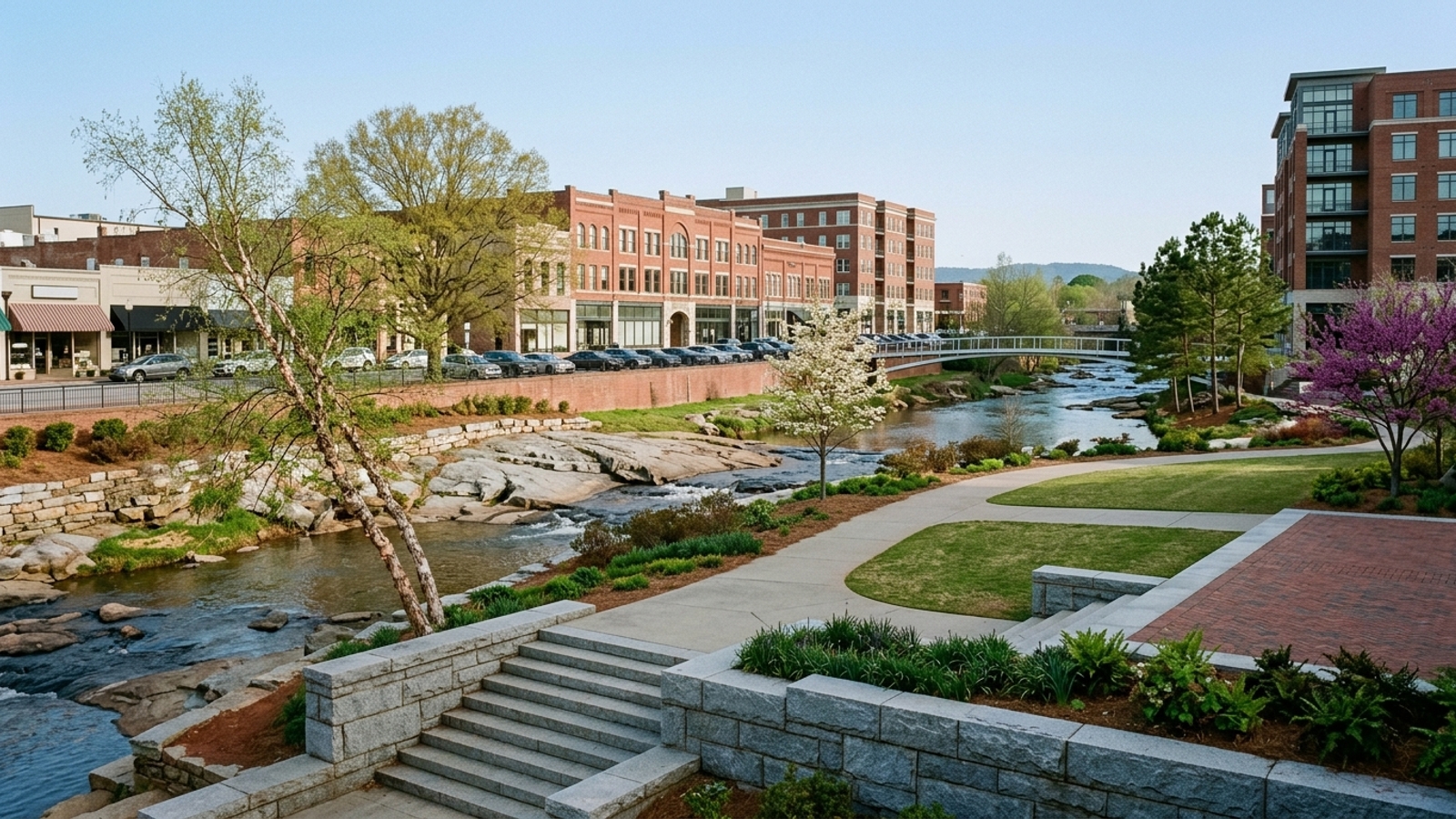
Greenville, SC and Greenville, NC solve different relocation problems. One sits on the I-85 corridor between Charlotte and Atlanta, backed by a manufacturing and corporate job base, with the Blue Ridge foothills a short drive away. The other is a university and medical center town on the flat coastal plain of eastern North Carolina, oriented toward Raleigh and the Atlantic.
If South Carolina is your destination, the headline number right now is a 13.4% single-family price drop, but that's not where your negotiating room lives. Townhouses in Greenville, SC sold at $247 per square foot, carried 7.9 months of supply, and saw zero closings above asking price. Single-family homes, by contrast, still moved in a median 64 days with 12.2% selling over list. The attached market is where sellers are waiting on buyers, not the other way around.
Key takeaway
Choose Greenville, SC if you want quick mountain access, a bigger city feel, and an I-85 manufacturing and corporate job base. Greenville, NC fits better if your work or studies tie you to East Carolina University or its medical center and you prefer living nearer the coast. If you land in South Carolina, the most negotiating room is in townhouses, which took a median 89 days to sell in the 90 days ending September 30, 2026.
Who this guide is for
You're relocating to one of the two Greenvilles and deciding which city fits, and if it's South Carolina, which type of home fits your budget, your work, and your weekends.
How the two Greenvilles differ
These are two entirely separate cities in different states, serving different daily lives. Buyers arriving from lower-cost markets are often surprised by the premium the Upstate location and job market commands.
A falling single-family median doesn't mean sellers will bend on price. What it means is that townhouse sellers currently have no recent over-asking sales to point to when you make an offer. To figure out which city aligns with your move, a few direct questions cut through the noise quickly.
Do you want the mountains or the coast within a weekend drive? Check the geography and storm risk section below. Is your job tied to a university or hospital, or to manufacturing and corporate offices along I-85? See the jobs section. If you choose South Carolina, do you need a detached house with a yard, or would you trade the yard for more space per dollar and room to negotiate? Review the property types breakdown. Does your state tax bill matter, especially if you'll be living on retirement income? Check the tax section and the FAQ on retiring.
Where each Greenville is located
Buyers confuse the two cities constantly during early searches, sometimes scheduling tours in the wrong state. Filter every listing search by state and confirm the ZIP code before you schedule a tour. Listings, search results, and shipping addresses mix these two cities up more often than you'd expect.
Greenville, South Carolina
Greenville, SC is the seat of Greenville County in Upstate South Carolina, sitting on the I-85 corridor between Charlotte and Atlanta at the edge of the Blue Ridge foothills. The metro stretches toward Greer and Spartanburg as well.
The city has an estimated population of 75,310, and Census data shows a median value for owner-occupied housing units of $487,500. Prices in prime locations match their reputation, and buyers arriving from lower-cost markets are often surprised by that premium.
Greenville, North Carolina
Greenville, NC is the seat of Pitt County, on the Tar River in eastern North Carolina's coastal plain. The terrain is flat. The city is oriented toward Raleigh and the Atlantic coast, not the mountains.
It's home to East Carolina University and ECU Health Medical Center, with an estimated population of 96,443 and a median owner-occupied housing value of $233,500. The trade-off is elevation: it sits a long drive from any serious hiking.
Greenville, SC home prices by property type
The all-homes median for Greenville, SC is $492,266 for the 90 days ending September 30, 2026. South Carolina costs more than the North Carolina side, but your budget stretches differently depending on what you're buying.
Buyers who want negotiating room should focus on attached homes. Townhouses and condos offer more room to work with right now. Detached houses are a different story.
Townhouses
Townhouses are where the supply is deepest and sellers are competing for buyers. At 7.9 months of inventory, you have real room to ask for concessions: closing-cost help, repairs, rate buydowns. No townhouse in this period closed above asking.
They run about $77 less per square foot than single-family homes. The trade-offs are HOA dues and no private yard. Before you submit an offer, get the current dues, the reserve study, and any planned special assessments in writing.
Condos
Condos carry the lowest entry price in Greenville, SC and tend to put you closest to downtown. Based on 42 condo sales, a typical condo closed about 4% under asking and took a median 97 days to sell, so there's time to negotiate.
Financing is building-specific. Ask whether the complex is FHA-approved or VA-approved, and find out what share of units are rentals. Both factors affect your loan options and your future buyer pool when it's time to sell.
Single-family homes
Single-family homes are still the most competitive product in Greenville, SC. The headline price drop is real, but detached houses move fastest and are the only type where a meaningful share sells over asking.
Even after that double-digit drop, about one in eight Greenville, SC houses sold above list price. Well-priced houses draw competition. Come in with pre-approval and be ready to decide quickly. Selection in the best locations is thinner than the overall inventory numbers suggest.
Greenville, SC neighborhoods to consider
Greenville, SC has several distinct neighborhoods with different housing styles and price points, and the right starting point depends on whether you want walkability, an older in-town home, or proximity to the city's expanding parks.
The property type conversation above matters more when you can connect it to a specific area, so here's how the main neighborhoods line up.
Downtown Greenville
Downtown is where the condo and walkability option concentrates. Main Street, Falls Park, and the Swamp Rabbit Trail are all within walking distance. Falls Park's Liberty Bridge, a curved suspension footbridge over the Reedy River falls, sits right in the middle of downtown.
Walkability comes with HOA dues, parking rules, and possible rental restrictions. Ask the HOA for dues, parking assignments, and the short-term rental policy in writing before you close.
North Main
North Main is established in-town streets just north of downtown, drawing buyers who want a detached house close to the city center. If you're weighing areas, compare North Main to Overbrook before settling on a budget.
Older homes mean you need to budget for systems work. Get the age of the roof, HVAC, electrical panel, and sewer line, and order a full inspection before your option period ends.
Augusta Road
Augusta Road is a popular in-town corridor south of downtown. Check our Augusta Road guide and the Augusta Road vs Alta Vista comparison for current price ranges.
Don't rely on citywide medians here. Pull the last six months of closed sales on the specific streets you're interested in before you set a budget, because pricing fluctuates widely.
West Greenville
West Greenville is a former mill district west of downtown that's actively being redeveloped. Unity Park, a large city park on the Reedy River, sits at the edge of this neighborhood.
Change is ongoing, which means the blocks around a home you buy today may look different in a few years. Check the City of Greenville's planning and development map for approved projects near any address before you commit.
State and local taxes compared
South Carolina assesses an owner-occupied primary home at a lower rate than non-owner-occupied property, while North Carolina uses a different system. For a detailed breakdown of everyday costs, compare your property tax bill and income brackets on our cost of living page.
Check each state's Department of Revenue for the current year's income tax schedule before you move, and confirm your specific situation with a tax professional.
State income tax
Both states have been adjusting rates year to year. Check the South Carolina Department of Revenue and the North Carolina Department of Revenue for the exact 2026 brackets that apply to your salary.
Trusting an older article on this one can lead to real miscalculations. The rules shift frequently, so verify the current schedule for the year you're planning to move.
Property tax on a home you live in
In South Carolina, a home you occupy as your primary residence is assessed at 4% of its value rather than 6%, but that rate isn't automatic. North Carolina uses a different valuation method in Pitt County.
You have to apply for the legal residence assessment with the Greenville County Assessor after closing. Skip that step and your bill gets calculated at the higher 6% rate.
Local economies and healthcare
East Carolina University and ECU Health anchor the Greenville, NC economy. Greenville, SC relies on manufacturing and corporate offices along I-85. Your work location is typically the deciding factor.
Greenville, SC job base
Greenville, SC's base is manufacturing, corporate offices, and healthcare along the I-85 corridor. BMW's plant in Spartanburg County, near Greer, is one of the largest BMW plants in the world.
Many of the major employers sit outside the city along I-85, so a Greenville address can still mean a commute toward Greer or Spartanburg. Drive your likely route at rush hour before you choose a side of town.
Greenville, NC job base
Greenville, NC runs on East Carolina University and ECU Health, two institutions that dominate the local employment market. If your work isn't tied to the university or the health system, check openings in your specific field before committing to the move.
Hospital systems
Greenville, SC is served by Prisma Health and Bon Secours St. Francis. Greenville, NC relies on ECU Health Medical Center. Before you move either direction, confirm that your health insurance network covers the local hospital system and your specialists, or you'll be paying out-of-network rates from day one.
Geography, weather, and storm risks
Greenville, SC is a short drive to the Blue Ridge. Greenville, NC is closer to the Atlantic. The weather patterns, weekend options, and insurance costs are different in each place.
Mountain access
Greenville, SC reaches state parks along the Blue Ridge escarpment quickly: about 50 minutes to drive 28 miles to Table Rock State Park, and about 1 hour and 18 minutes to reach the Blue Ridge Parkway. Greenville, NC is hours away from the mountains.
Greenville, SC sits in the foothills, not the mountains, so it's still a drive. Fall-weekend park traffic can be heavy, so check park reservation and parking rules before peak weekends.
Beach access
Greenville, NC is the coast-side choice. The drive from Greenville, NC to Atlantic Beach is about 1 hour and 44 minutes, and reaching the Outer Banks takes roughly 2 hours and 37 minutes.
From South Carolina, the nearest beaches are a multi-hour drive each way. Weekend beach plans require an early start or an overnight stay.
Hurricane and flood risk
The Tar River's flooding after Hurricane Floyd in 1999 is one of the worst flood events in North Carolina history. Upstate South Carolina sits further inland, but Hurricane Helene in 2024 still brought wind damage and power outages to the region.
Neither city is storm-free. Look up any address you're considering on the FEMA Flood Map Service Center and get homeowners and flood insurance quotes before your option period ends.
Travel options and daily commuting
Greenville-Spartanburg International Airport serves the South Carolina city. Greenville, NC residents often drive to Raleigh-Durham for flights. If you fly frequently for work or family, the airport situation in each city deserves a close look before you decide.
Airport access
Greenville-Spartanburg International Airport (GSP) sits between Greenville and Spartanburg near Greer. Pitt-Greenville Airport in North Carolina has limited commercial service, so many Greenville, NC residents use Raleigh-Durham instead.
GSP has fewer nonstop flights than larger hubs like Charlotte, and Greenville, NC flyers often face a drive to Raleigh. Check nonstop flights to the cities you visit most from GSP, Pitt-Greenville, and Raleigh-Durham before you decide.
Interstate access
Greenville, SC sits directly on I-85 between Charlotte and Atlanta. Greenville, NC connects toward Raleigh and I-95 via I-587 and US-264.
I-85 through the Upstate is a busy freight and commuter corridor. Drive your likely commute at peak hours before you sign a contract.
Deciding between the two cities
The median home price in Greenville, SC is nearly double the median value in Greenville, NC. Your final call depends on your daily routine, your budget, and what you want to do on your days off.
Use the Greenville County Schools and Pitt County Schools assignment lookups for any address you're considering, and never assume school zoning from a listing. If crime data matters to you, compare each city police department's reports on the FBI Crime Data Explorer using the same year and per-capita rates.
When Greenville, SC fits better
Pick Greenville, SC if your work runs along I-85, you want mountains within reach, and you want a bigger city with a walkable downtown. Within South Carolina, start with townhouses or condos if you want negotiating room, or single-family homes if you need a yard and can move fast. LeAnne Carswell's team can pull recent townhouse or condo sales for the areas you're considering to help you start your search.
You pay for that location: the South Carolina median home price is higher, and detached houses still draw real competition. Be prepared to act quickly on anything well-priced.
When Greenville, NC fits better
Pick Greenville, NC if your job or studies tie you to East Carolina University or ECU Health, you want the coast within reach, and a smaller city suits you better.
You give up mountain access and easy flights, and you take on river-flood exposure. Check any address on the FEMA flood map and price flood insurance before you commit.
At a glance
- All homes, Greenville, SC: median sale price $492,266, down 8.8% year over year (245 sales, 90 days ending 2026-09-30)
- All homes, Greenville, SC: 71 median days on market, 97.2% sale-to-list, 8.7% sold above list, 5.3 months of supply, 425 homes for sale, $315 per sq ft (90 days ending 2026-09-30)
- Single-family homes, Greenville, SC: median sale price $543,783, down 13.4% year over year (167 sales, 90 days ending 2026-09-30)
- Single-family homes, Greenville, SC: 64 median days on market, 97.5% sale-to-list, 12.2% sold above list, 4.7 months of supply, 256 for sale, $324 per sq ft (90 days ending 2026-09-30)
- Condos, Greenville, SC: median sale price $359,963, down 1.4% year over year (42 sales, 90 days ending 2026-09-30)
- Condos, Greenville, SC: 97 median days on market, 96% sale-to-list, 2.4% sold above list, 5.4 months of supply, 73 for sale, $315 per sq ft (90 days ending 2026-09-30)
- Townhouses, Greenville, SC: median sale price $452,505, up 5.5% year over year (35 sales, 90 days ending 2026-09-30)
- Townhouses, Greenville, SC: 89 median days on market, 96.9% sale-to-list, 0% sold above list, 7.9 months of supply, 89 for sale, $247 per sq ft (90 days ending 2026-09-30)
Greenville, SC vs Greenville, NC FAQs
Is Greenville located in North Carolina?
Yes, there is a Greenville in North Carolina, but the two are entirely separate cities. Greenville, SC is the seat of Greenville County in Upstate South Carolina, while Greenville, NC is the seat of Pitt County in eastern North Carolina. Because they get mixed up so often, filter every listing search by state.
How far is Greenville, SC from Greenville, NC?
The driving distance from Greenville, SC to Greenville, NC is 347 miles. For scale, the driving distance from Greenville, SC to Charlotte, NC is just 101 miles. The trip between the two Greenvilles takes several hours by car.
Which Greenville is bigger?
As of July 1, 2025, Greenville, NC had a larger city population, with an estimated 96,443 residents. Greenville, SC had an estimated city population of 75,310 for the same date. The state of North Carolina is also larger overall, with an estimated population of 11,197,968.
Are home values higher in South Carolina or North Carolina?
Home values are higher in Greenville, SC, which has a median owner-occupied housing value of $487,500. Greenville, NC has a median owner-occupied housing value of $233,500. Statewide, North Carolina has a median owner-occupied housing value of $288,900.
Is it cheaper to retire in Greenville, SC or Greenville, NC?
It depends on your income sources. South Carolina fully exempts Social Security and allows a retirement income deduction of up to $10,000 for residents 65 and older. North Carolina taxes most pension, IRA, and 401(k) distributions at its flat individual income tax rate, except for specific government retirement benefits covered by the Bailey settlement. Review the property tax section above, check our cost of living page, and confirm your situation with a tax professional. This is not tax advice.
Which is warmer, Greenville, SC or Greenville, NC?
Official NOAA climatological normals for the 1991 to 2020 period are published for the Greenville-Spartanburg airport station in South Carolina. A comparable, official NOAA normals page specifically for Greenville, NC is not available to confirm exact city-specific differences. Check current local forecasts for the most accurate daily temperature comparisons.
Is Greenville, SC in the mountains?
No. Greenville, SC sits in the foothills, with downtown at an elevation of 984 feet above sea level. Getting to the actual mountains requires a drive: about 50 minutes to reach Table Rock State Park.
What is the downside to living in Greenville, SC?
Two common downsides are the summer heat and humidity and the car-dependent commutes along I-85. Drive your expected route at rush hour before you commit. Check our pros and cons guide for a full list of local trade-offs.
Sources
- Redfin: Data Center
- US Census QuickFacts Greenville city, SC
- US Census QuickFacts Greenville city, NC
- US Census QuickFacts North Carolina
- Travelmath: Driving distance from Greenville, SC to Greenville, NC
- Travelmath: Driving distance from Greenville, SC to Charlotte, NC
- South Carolina Department of Revenue: Individual Income Tax FAQ
- NOAA Climate Normals: GSP September
- National Weather Service: Flood Safety North Carolina
- Rome2Rio: Greenville, SC to Table Rock State Park
- Rome2Rio: Greenville, SC to Blue Ridge Parkway
- Travelmath: Driving time from Greenville, NC to Atlantic Beach, NC
- Travelmath: Driving time from Greenville, NC to Outer Banks
- Wikipedia: Downtown Greenville, South Carolina