


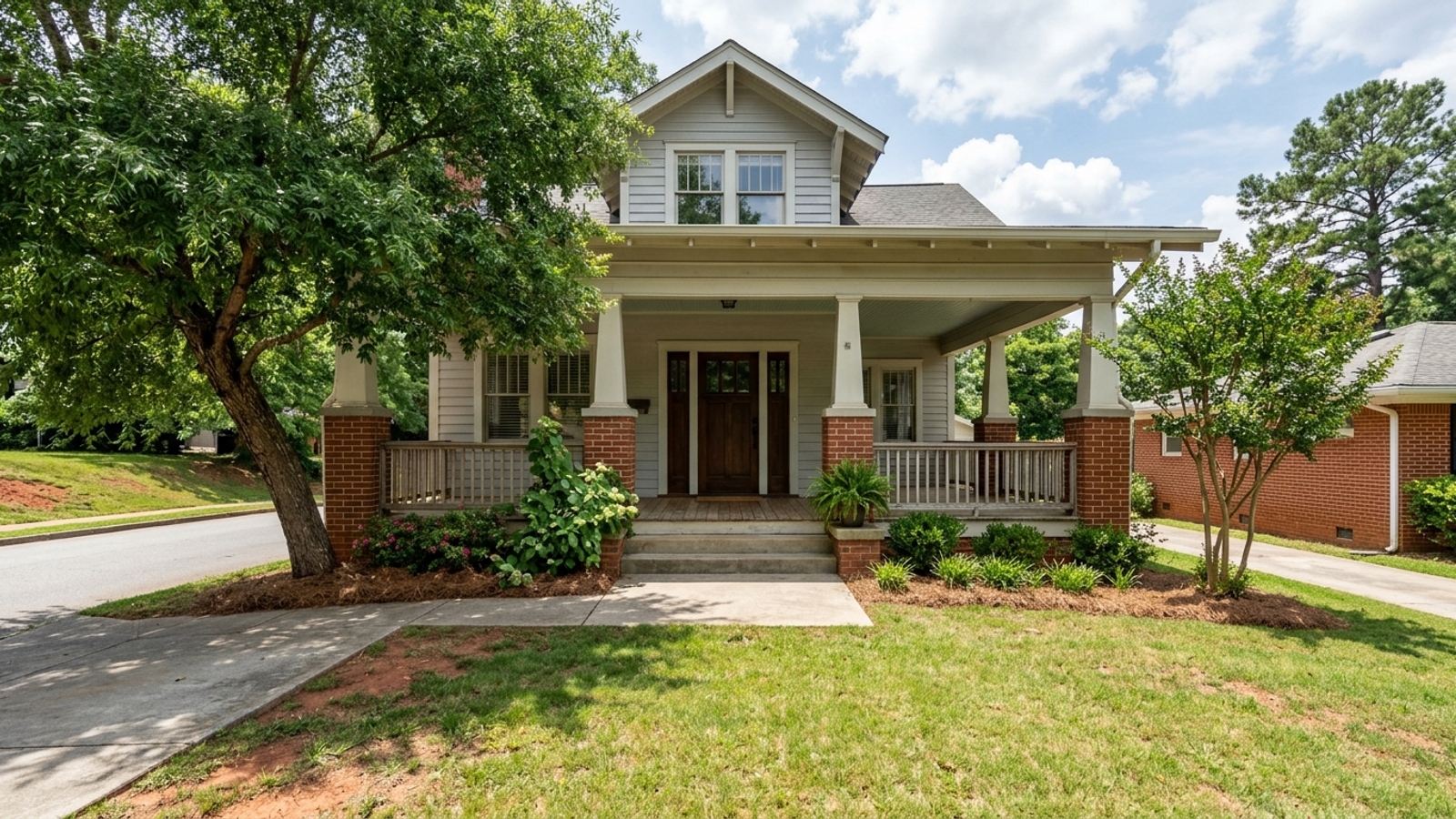
South Carolina's Upstate region offers two distinct economic hubs separated by a 32-mile stretch of Interstate 85. Buyers moving to the area usually weigh the larger downtown of Greenville against the manufacturing core surrounding Spartanburg.
The decision often comes down to balancing your monthly housing budget against your daily drive time. A true comparison of the two cities requires looking past general medians to examine specific home types, property tax rates, and the realities of rush hour traffic.
Key takeaway
Start in Greenville if you want the larger downtown and job hub and are buying a detached house. Single-family homes there are closing at 97.5% of list price after a year of falling values, so part of the discount that sends buyers to Spartanburg is now available in Greenville itself. Choose Spartanburg if its prices for your exact home type still come in clearly lower once you add the I-85 drive to wherever you work.
Who this guide is for
You are moving to or within the Upstate and deciding whether to buy in Greenville or Spartanburg based on price, home type, taxes, and your commute.
Is Spartanburg cheaper than Greenville?
Greenville's single-family median has fallen 13.4% in a year to $543,783, and Greenville townhouses sell for $247 a square foot against $324 for single-family homes. The price case for Spartanburg has to be rechecked home type by home type, with the I-85 commute factored in, before it decides your move. The Spartanburg side of this comparison rests on researching specific figures for your target house. Check our Greenville housing market page for full market trends and outlooks.
At a glance
- Greenville, all homes: median sale price $492,266, down 8.8% year over year; 245 sales (Redfin, 90 days ending 2026-09-30)
- Greenville, all homes: median 71 days on market, 97.2% sale-to-list, 8.7% sold above list, 5.3 months of supply, 425 homes for sale, $315 median per sq ft (90 days ending 2026-09-30)
- Greenville, single-family: median sale price $543,783, down 13.4% year over year; 167 sales (90 days ending 2026-09-30)
- Greenville, single-family: median 64 days on market, 97.5% sale-to-list, 12.2% sold above list, 4.7 months of supply, 256 for sale, $324 median per sq ft (90 days ending 2026-09-30)
- Greenville, condos: median sale price $359,963, down 1.4% year over year; 42 sales; median 97 days on market, 96% sale-to-list, 2.4% sold above list, 5.4 months of supply, 73 for sale, $315 median per sq ft (90 days ending 2026-09-30)
- Greenville, townhouses: median sale price $452,505, up 5.5% year over year; 35 sales; median 89 days on market, 96.9% sale-to-list, 0% sold above list, 7.9 months of supply, 89 for sale, $247 median per sq ft (90 days ending 2026-09-30)
Home prices by property type in Greenville vs Spartanburg
The choice between a detached house and an attached unit changes the financial math in both cities. You'll want to match the exact property style you need against what's currently available, because where you have the upper hand as a buyer depends entirely on what you're trying to purchase. A pre-approval for a townhouse puts you in a different negotiation than bidding on a single-family property.
Single-family homes
A Greenville single-family home sits on the market for a median of 64 days. That timeline gives you room to schedule inspections and negotiate a counteroffer instead of forcing a same-week decision. You'll need to check the current Spartanburg single-family median and price per square foot to see what the remaining gap is worth to you.
The catch: about one in eight Greenville single-family homes still sold above list price recently. Well-priced, well-located houses draw competition, so your negotiating power depends on the specific listing rather than applying evenly across the market.
Condos and townhouses
Greenville townhouses currently carry 7.9 months of supply. That's a strong buyer's market, and these units offer the most square footage for your money without leaving the city. Condos come in at a median $359,963, making them the lowest entry point in Greenville. Pull the Spartanburg townhouse and condo medians to compare, provided enough recent sales exist to form a reliable baseline.
What you give up is worth understanding: the oversupply that helps you negotiate today is the same competition you'll face when you eventually sell. HOA dues can also close the gap with a single-family payment faster than you'd expect. Ask the HOA for current dues, what they cover, and any pending special assessments before you compare monthly costs. If you're using FHA financing, check whether the complex is approved on HUD's lookup tool.
Living in Greenville vs Spartanburg
Each city anchors a different side of the Upstate economy, with Greenville as the corporate hub and Spartanburg as the manufacturing corridor. The choice between them extends past the purchase price into daily lifestyle and employment logistics, so you'll want to match your household's routine to the area that best supports it. The pros and cons of living in Greenville reveal the broader region's dynamics before you commit to a zip code.
Greenville, SC
Greenville offers the region's larger downtown and an expanding 32-mile network of trails known as the Prisma Health Swamp Rabbit Trail. The city-wide median sale price sits at $492,266, giving buyers access to diverse neighborhoods and a major job hub. Our cost of living guide and moving to Greenville resources outline typical daily expenses here.
Falling values cut both ways. A market down 8.8% in a year is good for your purchase price but a real risk if you may need to sell within a few years. Check recent comparable sales before you count this year's discount as equity.
Spartanburg, SC
Spartanburg features a smaller downtown and a massive manufacturing corridor for the Upstate. The BMW Group Plant Spartanburg campus sits right off Highway 85 in Greer, employing more than 11,000 people. That proximity explains why some buyers' jobs pull them closer to Spartanburg County.
If your job, your flights, or your evenings pull you toward Greenville, though, you pay back part of any price savings in I-85 drive time. Compare active listing counts in your price band, since a smaller city can mean fewer homes to choose from at any given moment.
Costs beyond the purchase price
The list price only tells part of the financial story in South Carolina. Property taxes and commuting expenses can quickly erase the upfront savings of a cheaper house, so you'll want to calculate these ongoing costs using your actual budget and driving habits. Small differences in municipal boundaries or highway exits add up over a year of ownership.
Property taxes in Greenville County vs Spartanburg County
South Carolina assesses an owner-occupied legal residence at a 4% ratio. For a $400,000 home, that equals a $16,000 assessed value, which is then multiplied by the local millage rate. For tax year 2025, Greenville County's base millage is 189.7 mills, while Spartanburg County's base operations millage is 53.7 mills.
City millage applies on top of those county rates only if the house sits inside city limits. The City of Greenville adds 81.4 mills; the City of Spartanburg adds 103.2 mills.
The 4% ratio applies only after you file for the legal residence rate after closing. A second home or rental is assessed at 6%, and whether an address falls inside city limits changes the bill considerably. Look up the exact parcel on the Greenville County or Spartanburg County assessor site to confirm the millage before you run your numbers.
Commuting on I-85
The commute between the two cities relies on Interstate 85, with the Greenville-Spartanburg International Airport (GSP) sitting roughly midway between them in Greer. GSP is about 15 minutes from downtown Greenville and 20 minutes from downtown Spartanburg. You'll need to check typical weekday rush-hour drive times to see how long the full trip takes during peak traffic.
Peak-hour I-85 slowdowns make the commute less predictable than the mileage suggests. Drive your actual commute route at weekday rush hour before you make an offer.
How to choose between Greenville and Spartanburg
Your final choice depends on a few practical questions about your daily life. Start with the home type: if you're buying a detached house, read the single-family section above to see where Greenville buyers have an advantage. If a townhouse or condo works, the condos section shows you Greenville's cheapest square foot.
Next, where will you work or fly from most weeks? If your job is in Spartanburg County or along I-85 toward it, review the commuting section and the Spartanburg profile before you price Greenville.
You should also ask whether you might need to sell within a few years. If so, read the Greenville profile's note on falling values before you treat this year's discount as a pure win. Finally, if the yearly tax bill matters as much as the purchase price, run the property tax section's worked example with your own target price. Closed sales from the last 90 days for your specific home type and size in both cities provide the clearest actual numbers for comparison.
Greenville, SC, vs Spartanburg FAQs
Is Greenville or Spartanburg better for buying a home?
It depends entirely on the type of home you want and where you'll commute for work. The "How to choose between Greenville and Spartanburg" section above walks through the specific trade-offs, starting with home type and commute.
Is Greenville, SC, still growing faster than Spartanburg?
Greenville's population grew by 5.9% from 2020 to an estimated 75,310 residents in 2025. Spartanburg had a population of 38,732 at the 2020 census, though reliable post-2020 official estimates were not confirmed. Check our moving to Greenville guide for more details on the area's growth.
What is the crime rate in Spartanburg, SC?
According to Spartanburg Police Department data for 2023, the department received reports of 2,580 property crimes, and aggravated assaults made up about 75 percent of violent crimes. In Greenville, 2023 police department data showed 358 violent crimes. City police and county sheriff data cover different areas, so review the official local agency reports directly.
How far is Greenville from Spartanburg?
The driving distance between downtown Greenville and downtown Spartanburg is approximately 32 miles. A typical drive time between the two downtowns takes about 36 minutes outside of peak traffic.
Is Greenville, SC, in Spartanburg County?
No, Greenville is the seat of Greenville County. The nearby city of Greer sits in both Greenville and Spartanburg counties, so for a Greer address you'll want to confirm which county it falls in, since the tax bill and school district follow the county line.
Do Greenville and Spartanburg share a school district?
No, the two areas operate completely separate school systems. Greenville County Schools is a single countywide district, while Spartanburg County is split into several numbered districts. Confirm the assigned school district for a specific address with the district's own lookup tool.
How much is rent in Greenville vs Spartanburg?
You'll need to check the current HUD Fair Market Rents for a two-bedroom in the Greenville-Anderson metro area versus the Spartanburg metro area. These figures act as official benchmarks rather than asking rents.
How far are Greenville and Spartanburg from Charlotte?
Spartanburg sits closer to Charlotte than Greenville does, though reliable official distance figures for each city to Charlotte were not found in this search. The drive from downtown Greenville to downtown Spartanburg covers roughly 32 miles, placing Spartanburg that much closer to the North Carolina border.
Sources
- Redfin: Data Center
- SC Department of Revenue: Chapter 5
- Greenville County Auditor: 2025 Millage
- Trippy: Greenville to Spartanburg
- SkyVector: GSP Airport
- U.S. Census Bureau QuickFacts: Greenville
- Wikipedia: Spartanburg
- WSPA: Greenville Police Crime Numbers
- Post and Courier: Spartanburg Crime Statistics
- Greenville Rec: Swamp Rabbit Trail
- BMW Group: Our Plant Spartanburg