


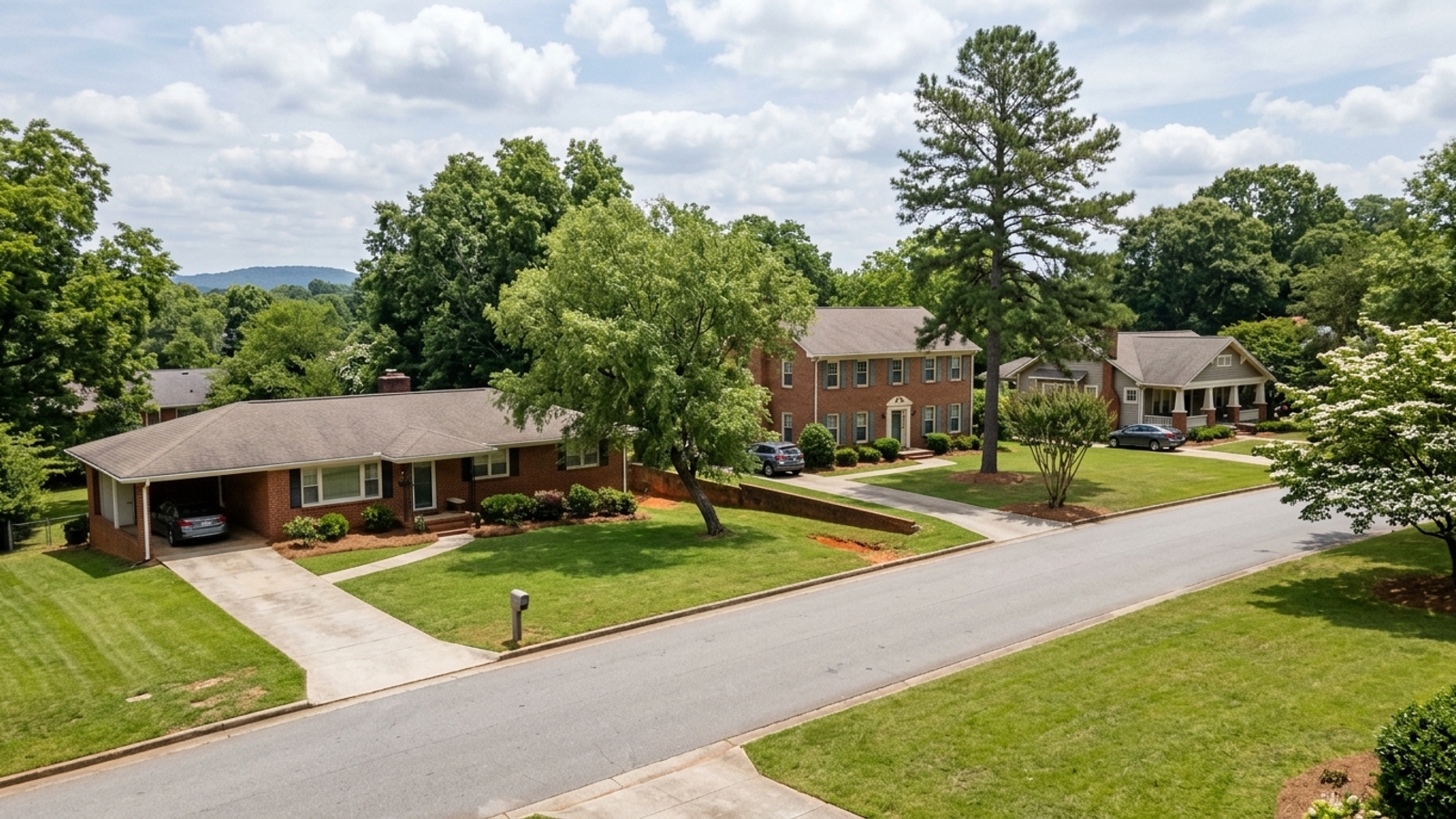
Across all home types, properties in Greenville, SC recently sold in a median of 71 days at 97.2% of their list price. That's over two months to evaluate a property before you commit, which is enough time to run the address-level checks that matter.
Key takeaway
Greenville's crime picture comes from official, town-level sources like the FBI Crime Data Explorer and the Greenville Police Department, but those rates only cover addresses inside city limits. Many Greenville mailing addresses fall under the County Sheriff instead, meaning the citywide numbers don't apply to them. With 5.3 months of supply across all Greenville home types recently, buyers have room to run address-specific checks on incident maps, flood zones, and insurance exposure before committing.
Who this guide is for
You're weighing a home purchase or rental in Greenville, SC and want to know what official data says, and what to verify about a specific address before you commit.
Crime data in Greenville, SC
A citywide crime rate divides all crimes reported in the city over a full year by the city-limits population to produce a per-resident average. It says nothing about any single street or home, and different aggregators often publish different numbers for the same city. Because the base is the city-limits population only, incidents involving commuters and visitors are counted against a smaller base. That can skew the rate in ways that are easy to miss.
Violent and property crime rates
The FBI Crime Data Explorer lists the latest full year of violent and property offenses for the Greenville Police Department jurisdiction. Compare those rates against the US Census Bureau's population estimate for the city limits. Treat them as a starting point rather than a final verdict on a property.
How crime numbers change over time
According to local news coverage of the Greenville Police Department's released data, the city's crime rate recently reached its lowest level in 25 years. The department reported an average 15.3% drop in crime over the prior year and noted that the decline coincided with population growth of more than 20,000 residents since 2000.
If you pull historical data from third-party sites, note that the FBI moved to a new national reporting system (NIBRS) in 2021. Agencies that reported incompletely during the switch can show artificial swings in their year-to-year numbers. Compare only years from the same source and the same reporting system to get an accurate trend line.
Why your address might not have city police coverage
A Greenville, SC mailing address doesn't mean the home is inside City of Greenville limits. Many homes with a Greenville address sit in unincorporated Greenville County, which means the city's crime rate may not describe the location at all.
The Greenville County Sheriff's Office General Order on Jurisdiction sets out the split. The Sheriff's Office shares concurrent jurisdiction with municipal police departments inside city limits, and it alone responds to calls in unincorporated areas, so those addresses rely entirely on the county.
Sheriff's Office data covers a much larger, mixed area, so its countywide figures aren't a substitute for a city-level rate. Use the official county GIS map to confirm whether the address is inside city limits or in unincorporated Greenville County, so you're pulling the right agency's data. Skip this step and you might spend time evaluating crime numbers from a police department that doesn't patrol the property.
Police, fire, and emergency services in Greenville
Different agencies respond to a 911 call depending on where a house sits. Addresses inside city limits are served by the Greenville Police Department and the City of Greenville Fire Department. Homes in the unincorporated county are covered by the Greenville County Sheriff's Office and various county fire districts.
For medical emergencies, Greenville County EMS operates under the county government as the sole 911 and advanced life support provider. It runs a high-performance system covering South Carolina's most populated county.
Fire coverage also affects your wallet. The City of Greenville Fire Department holds a Class I ISO Public Protection Classification, the highest rating available. Insurers use that classification as one factor in pricing homeowners policies, so confirming your specific fire district before you close can clarify what to expect on your insurance costs.
Safety checks for a specific Greenville home
Run these checks on the exact address during your due diligence period. Ask your closing attorney or agent exactly how long that period runs in your contract so you don't miss the window.
Check the official incident map for the address
The City of Greenville Police Department hosts a Crime Analysis page that includes a Crime Mapping tool. Look up the address on the official incident map for the correct agency over a 12-month window.
Incident maps plot reported calls and incidents, not convictions, and an incident is often mapped to the nearest block or business address. A handful of dots can mislead in either direction: one busy commercial address can dominate a view, and unreported incidents never appear. Visit the address at different times of day and see the street yourself.
Check the flood zone and drainage
FEMA issued an updated Flood Insurance Rate Map and Flood Insurance Study report for Greenville County and the City of Greenville in August 2014. Pull the FEMA flood map for the address to see if the property sits in a designated high-risk area.
A low-risk zone isn't a guarantee. Nationally, from 2014 to 2024, almost one-third (29%) of National Flood Insurance Program claims came from outside FEMA-designated high-risk flood areas. Flood maps also lag behind new construction and changing drainage.
Ask the seller about any past water intrusion or flood claims, and ask your inspector to note the grading and drainage around the foundation. Ignoring drainage is how buyers end up with unexpected water damage that standard homeowners insurance won't cover.
Check storm, tree, and insurance exposure
Greenville is far inland, yet the remnants of Hurricane Helene in 2024 still brought damaging wind and widespread tree falls to the Upstate. According to the National Weather Service, Helene's fast movement meant it was still a strong tropical storm when its wind field reached the western Carolinas. All customers in several Upstate counties lost power for at least a brief period.
Ask your inspector to note large trees near the roof and the overall roof age. During your due diligence period, get two things:
- a homeowners insurance quote, including the wind and hail deductible;
- a CLUE loss-history report.
Premiums and wind or hail deductibles vary widely by carrier and roof age, so a home that looks affordable can carry costs that change the math. Add that quote to your other household costs to see the true cost of living in the home before you set a budget.
Extra checks for a condo or townhouse
Condos and townhouses sell more slowly than detached houses (see the at-a-glance list), which gives you time to review the homeowners association. Ask for:
- current dues;
- the master insurance policy and deductible;
- the reserve study;
- fire and life-safety inspection records;
- any pending special assessments.
The HOA's master policy may not cover your unit's interior or a special assessment after storm damage, so verify these coverage details yourself.
How the Greenville market affects your due diligence
Your room to negotiate repairs or ask for records depends on how fast the market is moving. In the 90 days ending Sept. 30, 2026, the median single-family sale price fell 13.4% year over year to $543,783, based on 167 sales, with 4.7 months of supply.
At that pace, sellers generally expect inspections and negotiation. You can usually ask for repair credits on roof, tree, or drainage findings without immediately losing the house to another bidder. Some properties still draw above-list offers, so your bargaining position varies by listing.
If you need help pulling disclosures, checking the county GIS, or pulling FEMA flood maps for a specific home, LeAnne Carswell at Expert Real Estate Team can handle that research for you.
How to narrow your Greenville decision
Start by confirming whether the address is inside City of Greenville limits or in unincorporated Greenville County, using the steps in "Why your address might not have city police coverage." That single check decides which agency's data applies.
Next, check whether the home is near a creek, the Reedy River, or low ground. If it is, pull the FEMA map before you make an offer, as described in "Check the flood zone and drainage."
Then consider the property type you want to manage. Detached houses put roof, tree, and insurance exposure on you; attached homes add HOA and building records. The storm and condo/townhouse checks above cover each. How much negotiating room each type gives you is covered in "How the Greenville market affects your due diligence."
- If you want the most time to collect HOA, insurance, and building records before you commit, start with condos. They're the slowest-selling type on the page, so sellers rarely face competing offers.
- If you want room to ask for repair credits after a roof, tree, or drainage inspection, start with single-family homes.
- If you want the widest choice with no bidding pressure, start with townhouses.
Crime and hazard checks answer only part of whether Greenville suits you, so weigh them against the pros and cons of living in Greenville and the logistics of moving to Greenville.
Greenville home market at a glance
- All homes, 90 days ending Sept. 30, 2026 (245 sales): median sale price $492,266, down 8.8% year over year; median 71 days on market; 97.2% sale-to-list; 8.7% sold above list; 5.3 months of supply; 425 homes for sale; $315 median price per sq ft
- Single family, 90 days ending Sept. 30, 2026 (167 sales): median sale price $543,783, down 13.4% year over year; median 64 days on market; 97.5% sale-to-list; 12.2% sold above list; 4.7 months of supply; 256 for sale; $324 per sq ft
- Condo, 90 days ending Sept. 30, 2026 (42 sales): median sale price $359,963, down 1.4% year over year; median 97 days on market; 96% sale-to-list; 2.4% sold above list; 5.4 months of supply; 73 for sale; $315 per sq ft
- Townhouse, 90 days ending Sept. 30, 2026 (35 sales): median sale price $452,505, up 5.5% year over year; median 89 days on market; 96.9% sale-to-list; 0% sold above list; 7.9 months of supply; 89 for sale; $247 per sq ft
Greenville, SC safety FAQs
How does Greenville's crime rate compare with the South Carolina and national averages?
According to SLED's 2024 Crime in South Carolina Annual Report, the state's violent crime rate fell 8.4% from 2023 to 2024, reaching its lowest rate since 1995, and the property crime rate fell 11.8%. FBI Crime Data Explorer estimates for 2024 put the national violent crime rate at 380.7 and the property crime rate at 1,954.4 per 100,000 residents, benchmarks to set beside the Greenville Police Department's local rates.
Is Greenville, SC safer than Charlotte, NC?
Pull the violent and property crime rates for the Charlotte-Mecklenburg Police Department and the Greenville Police Department from the FBI Crime Data Explorer for the same year. Differences in agency coverage and reporting practices can still skew a comparison between two cities.
Is Greenville, SC safe to walk at night?
The City of Greenville runs a Downtown Public Safety Initiative to manage activity in the city center. For a specific street, visit at night to see the lighting and foot traffic yourself.
Is Greenville, SC safe from hurricanes?
Greenville is far inland, but storm remnants still reach it: Helene brought damaging wind, tree falls, and power outages to the Upstate in 2024. Check the roof, nearby trees, and the wind and hail deductible before you buy.
Do I need flood insurance to buy a home in Greenville?
Yes, if you use a federally backed mortgage to buy a property located within a FEMA Special Flood Hazard Area. Outside that zone it isn't federally required but is available to anyone in a participating community, so get a quote anyway.
Is Greenville, SC tap water safe to drink?
The latest Greenville Water Consumer Confidence Report shows whether the system met federal standards for the reporting year. If you're buying a county home that relies on a private well, arrange your own water testing during the inspection period.
Is Greenville, SC in a drought?
As of the South Carolina Drought Response Committee's September 8, 2026 meeting, Greenville County is in Incipient Drought status. It was downgraded from Moderate after sustained improvement in Upstate streamflow levels; check the committee's page for the latest status.
How much snow and ice does Greenville, SC get?
National Weather Service Greenville-Spartanburg data covers average annual snowfall and winter storm climatology. The area does see occasional ice storms that cause tree and power-line damage, so ask the seller about past outage repairs or existing generator hookups.
Sources
- Redfin: Data Center
- WSPA: Greenville crime drops to lowest level in 25 years
- Greenville County Sheriff's Office: General Order 105
- City of Greenville: Crime Analysis
- City of Greenville: ISO Designations
- City of Greenville: Flood Maps
- FEMA: Floods Can Happen Anywhere
- National Weather Service: Hurricane Helene Event Summary
- The Item: Drought continues to impact South Carolina