


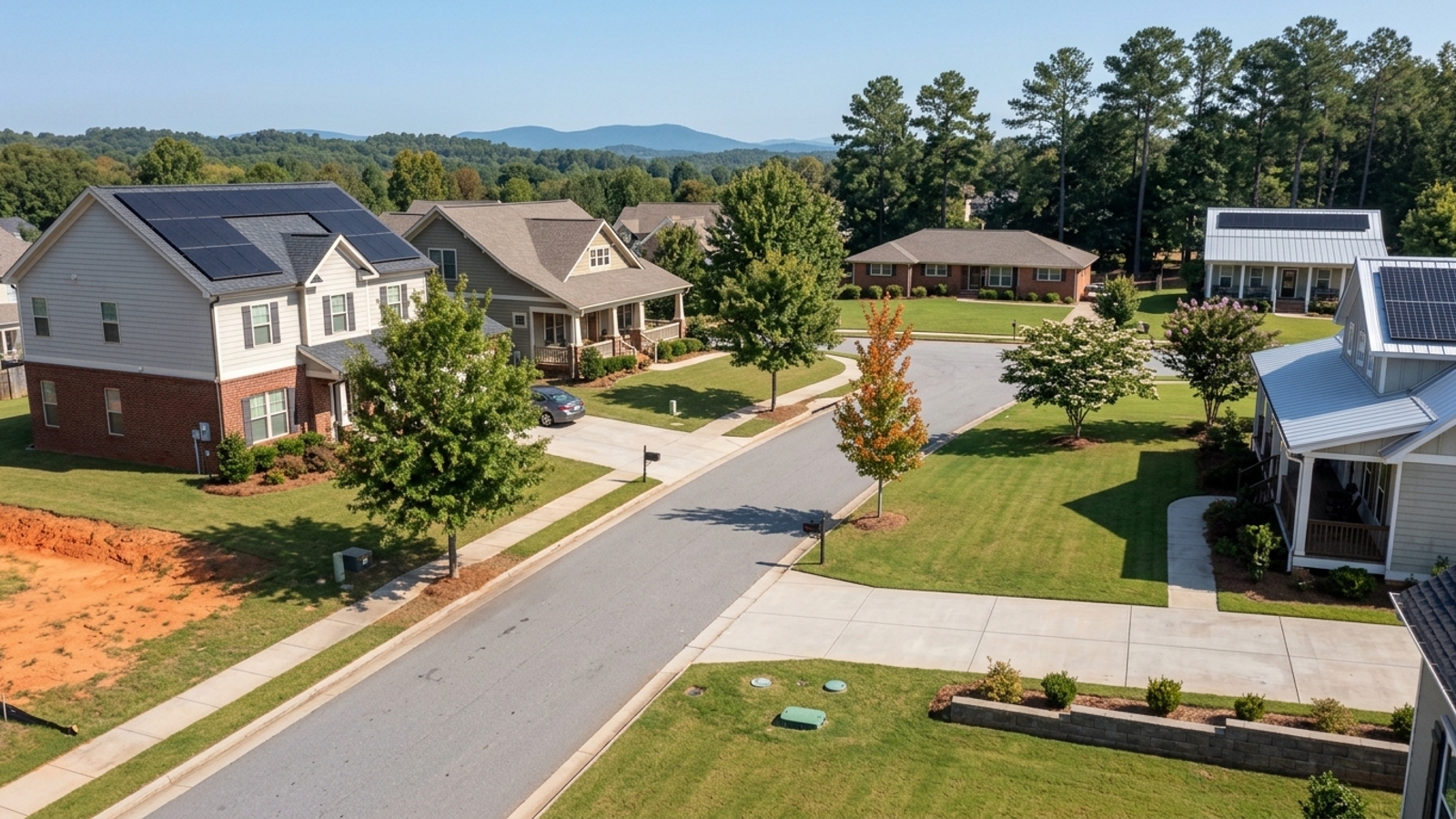
In Greenville, SC, the name of the city on your mailing address does not dictate which utility companies bill you.
Key Takeaway
Most Greenville addresses get electricity from Duke Energy, water from Greenville Water, and sewer treatment through ReWa. Gas, trash, sewer collection, and whether a home is on a well or septic depend on the exact address, so confirm each provider before making an offer. Homes are selling for a median 97.2% of list price, which gives you room to ask the seller for 12 months of utility bills first.
Who This Guide Is For
You're buying or moving into a home in Greenville and need to know which companies will serve that address, what to set up before closing, and roughly what the bills will look like.
Why Utilities in Greenville Depend on the Address
A Greenville mailing address doesn't guarantee you're inside Greenville city limits, and those boundaries decide many of your utility providers. Four factors change who bills you:
- whether the property sits inside the incorporated city or in the unincorporated county
- whether it falls in Duke Energy or an electric cooperative's territory
- which local agency collects the sewage
- whether the home connects to public lines or relies on a private well and septic system
ZIP codes don't follow city limits, so the ZIP codes and area breakdown can't tell you a home's utility setup. Confirming every provider before closing lets you budget accurately and avoid moving into a house with an unexpected well or septic maintenance bill. Utility providers vary by address; weighing the pros and cons of living in Greenville, SC involves checking these local differences.
Electricity and Natural Gas in Greenville
In South Carolina, you don't pick your electric company. The service territory is assigned to the physical address, so you buy power from whichever provider owns the lines running to the house. Natural gas only exists where a main runs down the street. An all-electric home has one energy account; a home with gas has two.
Duke Energy and the Electric Cooperatives
Duke Energy Carolinas serves most addresses inside city limits. Toward the outer edges of Greenville County, some homes buy power from one of two member-owned cooperatives instead:
- Laurens Electric Cooperative serves parts of Greenville, Spartanburg, Anderson and other counties.
- Blue Ridge Electric Cooperative supplies power to portions of Anderson, Greenville, Oconee, Pickens and Spartanburg counties.
Confirm the provider with its online service-area lookup or by calling with the address. If the house is in a territory with higher rates, that cost comes with the address.
Piedmont Natural Gas
Piedmont Natural Gas serves Greenville, SC, and is listed by Greenville County as the natural gas utility to contact for starting or stopping gas service. Their customer service line is 800-752-7504.
Many newer subdivisions and rural lots have no gas main at all. Adding gas to an all-electric house means submitting a line extension request, and the provider decides whether it's feasible and what it will cost. Verify the main's location before planning on a gas stove.
All-Electric vs. Gas Homes
In an all-electric home with a heat pump, summer cooling and winter heating both land on the same bill. A gas furnace or gas water heater splits usage across the two accounts, each with its own monthly base customer charge. Check the listing or the HVAC data plate to confirm the heating fuel.
Neither setup is automatically cheaper. The age and efficiency of the system matter more than the fuel type, and you learn those from the home inspection and the seller's past bills. Replacing an aging gas furnace or heat pump is a major expense, so weigh the equipment's condition over what it runs on.
Water, Sewer and Trash in Greenville
Greenville Water supplies the city and a large portion of the surrounding county, so a county address often still connects to public water. Effective January 1, 2026, Greenville Water's residential rates for a standard 5/8-inch meter are:
- Inside the City of Greenville: a $5.97 monthly base charge plus $1.93 per 1,000 gallons
- Outside city limits: an $8.23 base charge plus $2.68 per 1,000 gallons
Sewer and trash are more fragmented. Two agencies handle wastewater, one treating it and one collecting it. Garbage collection shifts from municipal pickup inside the city to other arrangements in the county. A home inside city limits on Greenville Water and public sewer has the fewest separate accounts and needs no well or septic testing.
Greenville Water
Greenville Water's service area reaches well beyond city limits, but being inside it doesn't mean every lot is connected. Rural parcels can sit near a main and still use a well. Ask Greenville Water whether the specific parcel is connected rather than relying on a map, and tie the start of service to your closing date.
Sewer: ReWa and Local Collection
A Greenville homeowner can see two sewer charges, one for treatment and one for collection, because two different agencies handle them.
ReWa (Renewable Water Resources) treats wastewater for much of the county. Its charge appears as a line item on the customer's water provider bill and is made up of a base charge plus a volume charge based on metered water use. Customers in northeastern Greenville County and in Anderson County are billed separately and contact ReWa directly for rates.
A separate local body owns the pipes that carry wastewater to treatment:
- Within Greenville city limits, the City of Greenville charges its own residential sewer rate based on meter size and usage.
- In unincorporated Greenville County, MetroConnects handles collection and charges residential customers a monthly base charge plus a volume charge per 1,000 gallons of water used. MetroConnects charges are separate from and in addition to ReWa's treatment charges.
Trash and Recycling Inside the City
City of Greenville residents get municipal garbage and recycling collection. The city issues specific carts for the property, and the cost may appear on your annual property tax bill or a utility bill rather than as a separate monthly invoice.
Bulk items and yard debris have their own rules and pickup schedules. Some homeowners associations or condo buildings use a private contract instead, so ask the HOA what's included before counting on city pickup.
Trash in Unincorporated Greenville County
In unincorporated areas, Greater Greenville Sanitation handles curbside pickup in certain spots. Elsewhere, residents hire a private hauler or take trash themselves to one of Greenville County's seven residential waste and recycling centers. The centers have three rules:
- a limit of three cubic yards per vehicle per day
- residential waste only
- proof of residence required
If the home is outside city limits, ask neighbors or the HOA which hauler serves the street. That's an extra monthly contract sellers rarely mention, so add it to your budget.
Homes on a Well or Septic System
Without public water or sewer lines, testing and maintenance fall entirely to you. Verify water quality, the pump's condition and the septic system's capacity before closing, and write the well and septic inspections, or a credit, into the offer.
What to Test Before You Buy a Home with a Well
No utility tests a private well's water. South Carolina doesn't regulate the water quality of private wells. SCDES recommends that any testing intended for real estate transactions be sent to a commercial laboratory found on the Environmental Laboratory Certification webpage rather than to SCDES itself. An owner can get a sample kit from their local SCDES Regional Office or Health Department.
Bacteriological results typically take two to three weeks; metals or minerals testing typically takes eight to 12 weeks. Before closing:
- Order a certified lab water test.
- Ask the seller for the pump's age and service records.
- Check with your lender whether a water test is required for your loan type.
A passing test is only a snapshot. Pump age, well depth and recovery rate don't show up in a water-quality report.
What to Check on a Septic System
Request the septic permit records and schedule a pump-out and inspection before closing. The county permits the system for a set number of bedrooms, so the permit confirms it matches the home's size. Septic repairs and drain-field replacements become your problem after closing unless they're negotiated first.
Connecting to Public Water or Sewer Later
If a Greenville Water main or public sewer line runs near the property, connecting later may be possible. Availability depends on the line's distance and capacity. Get the provider's answer for that exact parcel in writing before treating a hookup as a future upgrade.
Internet Service in Greenville
Internet options vary street by street, so a citywide list of providers doesn't tell you much. The FCC's National Broadband Map (broadbandmap.fcc.gov) is the federal government's official tool for checking availability at a specific address. Search the exact address there, and the map shows the fiber, cable, DSL, satellite or fixed wireless services that ISPs report as available through the FCC's Broadband Data Collection program. Confirm on providers' sites and ask the seller what service the home has now. Speeds advertised for an area may not reach a specific lot, especially on rural parcels.
How to Set Up Utilities Before You Move
Waiting until after closing to call providers often leaves a gap in service on move-in day. Start during the due-diligence period and finish the week of closing.
Step 1: Confirm Every Provider for the Address
Use the county's property records lookup during the due-diligence period to confirm whether the home is inside city limits. Then verify the electric, water, sewer and gas providers by address. The listing's utilities field is often incomplete or generic, so check each provider directly.
Step 2: Schedule Start Dates Around Closing
Call the electric, water and gas companies with your closing date so service transfers into your name that day. Coordinate with the seller so nothing is shut off between the two accounts. If the seller stops service before yours starts, reconnection can mean a technician visit and a fee, so start on the closing date itself, not the day after.
Step 3: Arrange Trash and Internet Separately
Trash and internet need the most lead time and are the easiest to forget. Set up a private hauler contract or submit a city cart request, and book an internet installation. Install windows can run a week or more out, so book as soon as you have a firm closing date.
Step 4: Stop or Transfer Service at Your Old Home
Schedule stop dates for the day after you hand over the keys to your old place. Give each provider a forwarding address for final bills and deposit refunds. Final bills can arrive weeks later, and a missed one can follow you to collections, so keep a list of every account you closed. Book the rest of your moving logistics, such as movers and the truck, around the same closing date.
How to Estimate Monthly Utility Costs for a Specific Home
Square footage, system age, insulation and the previous owner's habits all change a home's monthly total, so regional averages are only a starting point. Gather figures for the specific house instead. Utilities are one part of the full household budget, so add them to housing, insurance and taxes when you work out your cost of living.
Ask the Seller for 12 Months of Bills
Twelve months of electric, gas, water, sewer and trash bills capture both summer cooling and winter heating. Request them through your agent before or during the due-diligence period. Also ask the HOA which utilities, trash service or water the dues cover. The seller's usage reflects their household, thermostat habits and occupancy, so treat the bills as a range, especially if the home sat vacant for part of the year.
What Drives Utility Bills Up in a Greenville Home
Several features push costs higher:
- HVAC age and efficiency
- ductwork condition
- insulation levels in older homes
- lawn irrigation on a metered water line
- a pool, which adds to both water use and the sewer volume charge tied to it
An older system can pass inspection and still be inefficient, because an inspector checks whether it works, not what it costs to run. Ask the inspector to note the HVAC and water heater ages so you can price a replacement before you're committed.
Using Today's Market to Negotiate
At the current pace of sales, sellers have reason to agree to bill requests, well or septic inspections, or credits for aging systems. Townhouses have the most supply of any home type, so they offer the most room to negotiate. Supply and prices shift month to month, so check current housing market figures and trends before writing an offer.
The Expert Real Estate Team can help you request the bill history and necessary inspections during the negotiation process. Your negotiating power varies by home type and listing, though, so a well-priced detached home in demand may still draw competition. Pick the requests that matter most for that specific house.
At a Glance
- Median sale price, all homes: $492,266, down 8.8% year over year (90 days ending 2026-09-30)
- Median days on market, all homes: 71 (90 days ending 2026-09-30)
- Sale-to-list ratio, all homes: 97.2%, with 8.7% of homes selling above list (90 days ending 2026-09-30)
- Months of supply, all homes: 5.3 (90 days ending 2026-09-30)
- Median sale price, single-family homes: $543,783, down 13.4% year over year, 64 median days on market (90 days ending 2026-09-30)
- Condos: 97 median days on market, 96% sale-to-list, based on 42 sales (90 days ending 2026-09-30)
- Townhouses: 7.9 months of supply, 0% sold above list, based on 35 sales (90 days ending 2026-09-30)
Greenville, SC, Utilities FAQs
Where Does Greenville, SC, Get Its Water From?
According to Greenville Water's 2025 Water Quality Report, it draws from Table Rock Reservoir, North Saluda Reservoir and Lake Keowee. The Stovall Treatment Plant is supplied by Table Rock and North Saluda, and the Adkins Treatment Plant by Lake Keowee.
Can I Drink the Tap Water in Greenville, SC?
Yes, the municipal water meets federal standards based on Greenville Water's 2025 Water Quality Report. Homes on private wells aren't covered by that report and need their own certified lab test.
What Is the Average Water Bill in Greenville, SC?
Water itself is billed at the base-plus-volume rates listed in the water section above. Sewer adds more: per the SC Rural Infrastructure Authority's 2024 survey, ReWa's inside residential sewer rate was $47.30 per month based on 5,000 gallons of usage.
What Is the Average Electric Bill in SC?
According to the U.S. Energy Information Administration's 2024 Average Monthly Bill data, South Carolina's average residential electricity bill was $149.51 per month, based on 1,050 kWh at an average price of 14.23 cents per kWh. A specific home will differ, so check the seller's 12-month bills.
Is Greenville, SC, in a Drought?
As of the South Carolina Drought Response Committee's September 8, 2026 meeting, with no change reported through its October 8, 2026 update, Greenville County was downgraded from Moderate to Incipient Drought after sustained improvement in streamflow levels. Check the current status with the state, since conditions change.
How Much Does It Cost to Switch from a Well to Greenville Water?
Per Greenville Water's 2026 rate schedule, connection fees for a 5/8-inch residential connection are set via the capacity fee schedule, while larger connections such as a 3-inch meter run $2,800 inside the City of Greenville versus $44,160 outside city limits. The homeowner typically also pays a plumber for the line from the meter to the house.
Is Well Water Cheaper than City Water in Greenville County?
It depends on your maintenance costs compared to Greenville Water's rates. Well owners avoid monthly water bills but pay for the electricity to run the pump, periodic lab testing and eventual pump replacement, so get quotes from a licensed well contractor to compare.
Do Duke Energy and Piedmont Natural Gas Require a Deposit in Greenville?
Duke Energy requires all residential customers to establish credit before electrical service is connected, and it runs a credit check for new customers at application to decide whether a security deposit is required. Ask each provider directly how your credit history or a letter of credit from a prior utility can waive the deposit.
Sources
- Redfin: Data Center
- Laurens Electric: About
- Duke Energy: Security Deposit Options
- Greenville County: Utilities
- Greenville Water: Rates
- Greenville Water: 2025 Water Quality Report
- ReWa: Services
- City of Greenville: FAQ
- Greenville County: Residential Waste
- SC DES: Environmental Laboratory Services
- EIA: Average Monthly Bill Data
- FCC: Broadband Data Collection
- SC Drought Response Committee: Updates